













In Photos: Bizarre, Blood Red-Fanged Spiders
Mark Wong of the Australian National University was surprised when he turned over a rock in Tallaganda State Forest, in New South Wales, not because there was a scary-looking spider looking back at him. Rather, it was the spider's coloring: Rather than wearing an all-black attire, t his funnel-web spider sported blood-red fangs. Here's a look at the funky spider Wong observed for the first time. [Read the full story on the redhead spider]
Blushing?

Funnel-web spiders (Atrax sutherlandi) are typically all black, but here, a female spotted by Wong in the forest dons blood-red fangs. (Photo Credit: Mark Wong)
Silken tunnel

These creepy-crawlies get their name from the funnel-like structure they weave from their spider silk. The wispy funnel, where the spider lurks when waiting for prey, leads to the spider's silken burrow. (Photo Credit: Andras Keszei)
Fighting stance
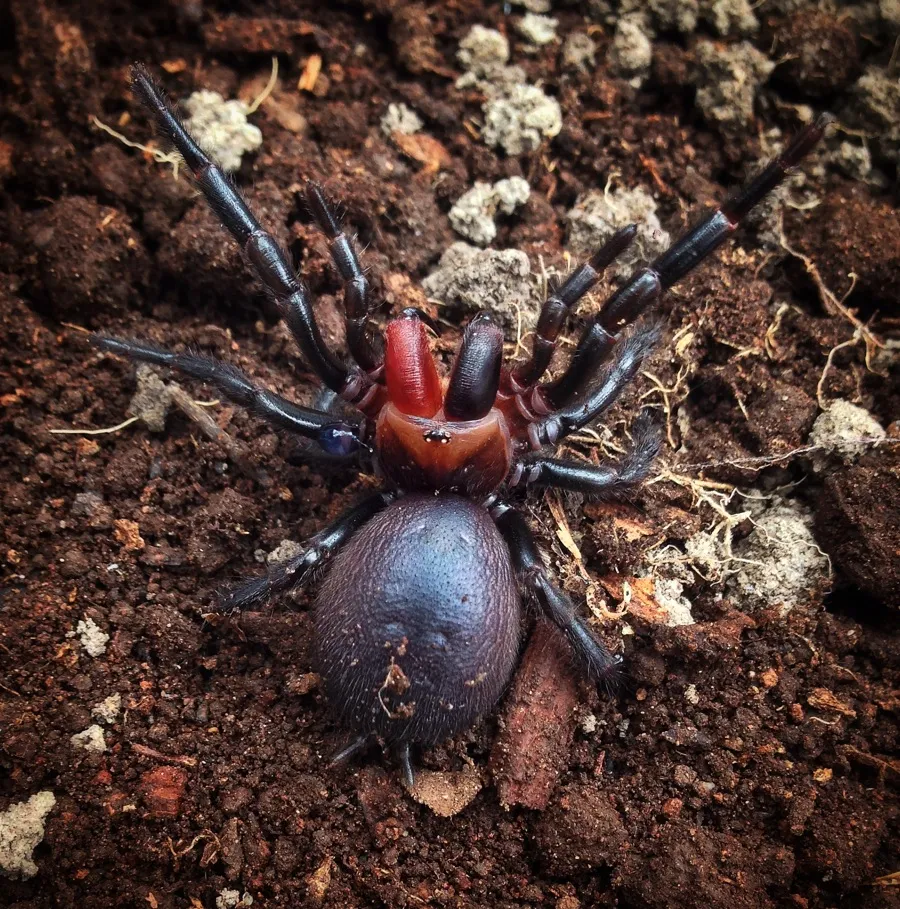
When the funnel lurker spies a meaty meal, it will run out of its hiding spot, rear up on its hind legs, and capture the prey, before bringing it back into its burrow. Here, the oddly colored female funnel-web spider rears up in a ready-to-strike pose. (Photo Credit: Mark Wong)
Get the world’s most fascinating discoveries delivered straight to your inbox.
Ready to attack

Another look at the female preparing to pounce. The species' scientific name — Atrax sutherlandi — honors the late Struan Sutherland, whose research resulted in a successful funnel-web spider antivenom, according to an article published in 2010 in the Records of the Australian Museum. (Photo Credit: Mark Wong)
Deadly bites

Another female Atrax sutherlandi showing off the spider's typical black coloration. This species belongs to the subfamily Atracine, known colloquially as the Australian funnel-web spiders. Atracine is a subfamily of the family Hexathelidae, one of three families of funnel-web spiders. Two species within the family have deadly bites: the Sydney funnel spider and the northern tree funnel spider. (Photo Credit: Mark Wong) [Learn more about funnel-web spiders]
Curvy females

For funnel-web spiders the gals have the curves: Here, a vagrant male can be distinguished from the heavier-built female from its slender shape. (Photo Credit: Andras Keszei)
In action
Follow Live Science @livescience, Facebook & Google+.
Jeanna Bryner is managing editor of Scientific American. Previously she was editor in chief of Live Science and, prior to that, an editor at Scholastic's Science World magazine. Bryner has an English degree from Salisbury University, a master's degree in biogeochemistry and environmental sciences from the University of Maryland and a graduate science journalism degree from New York University. She has worked as a biologist in Florida, where she monitored wetlands and did field surveys for endangered species, including the gorgeous Florida Scrub Jay. She also received an ocean sciences journalism fellowship from the Woods Hole Oceanographic Institution. She is a firm believer that science is for everyone and that just about everything can be viewed through the lens of science.