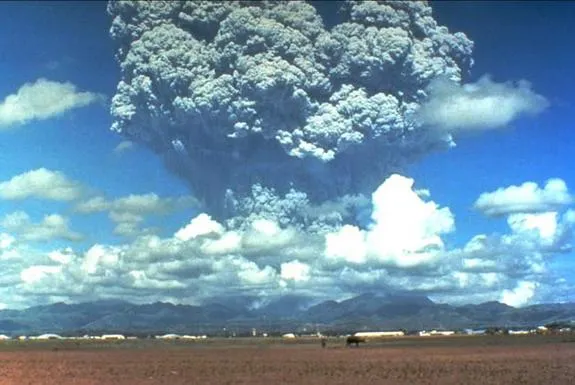
Two hundred years after the biggest volcanic blast in recorded history, scientists have ranked the countries most at risk of a deadly volcanic eruption.
Today (April 10) marks the 200th anniversary of the 1815 Tambora eruption in Indonesia. The enormous explosion changed global climate, causing a "year without a summer" in the Northern Hemisphere. Sulfur dioxide from Mount Tambora lingered in the atmosphere for several years, cooling the planet and triggering crop failures, famine and human disease pandemics in North America, Europe and Asia.
"People were eating cats and rats," said Stephen Self, a volcanologist at the University of California, Berkeley and an expert on the Tambora eruption.
There is a 30 percent chance of another Tambora-size eruption striking this century, according to a new global volcanic hazard report prepared for the United Nations. An international team of experts, known as the Global Volcano Model Network, culled reports of the death and destruction wrought by volcanoes and ranked the countries most likely to face such future disasters. The report, called "Global Volcanic Hazards and Risk," will be published in May by Cambridge University Press.
Indonesia remains the country most at risk of another deadly volcanic eruption, according to the new report. To create the rankings, the scientists considered how often volcanoes within a country have erupted in the past 10,000 years and their different hazards. For example, ice-covered volcanoes can unleash fast-flowing mudflows called lahars. One of the most lethal volcanic events in the past 400 years was a lahar that raced down Colombia's Nevado del Ruiz volcano in 1985, killing more than 23,000 people. [10 Most Hazardous Countries for Volcanoes (Photos)]
The report's authors also accounted for the number of people living in a volcano's blast zone (800 million people live within 62 miles, or 100 kilometers, of a volcano, on average around the world) and whether the volcano has killed before.
Following Indonesia on the list of most-threatened countries are the Philippines, Japan, Mexico, Ethiopia, Guatemala, Ecuador, Italy, El Salvador and Kenya.
Sign up for the Live Science daily newsletter now
Get the world’s most fascinating discoveries delivered straight to your inbox.
However, some countries are more vulnerable to volcanic threats than others. Island nations, whose populations must flee an eruption, are more exposed to a volcano's deadly hazards, according to the report. Small countries are also more vulnerable. By this measure, the rankings place Montserrat, St. Vincent and the Grenadines, the West Indies, Dominica, the Azores, St. Lucia, the Atlantic-United Kingdom Islands, El Salvador and Costa Rica among the small countries and island nations most vulnerable to volcanic eruptions.
On guard
Mount Tambora's devastating eruption was not without warning. The volcano first rumbled to life in 1812. But before it awakened, Tambora was dormant for more than 1,000 years, and many villages were clustered on the volcano's lush slopes. Because no one evacuated before 1815, more than 10,000 people were killed by pyroclastic flows and tsunamis.
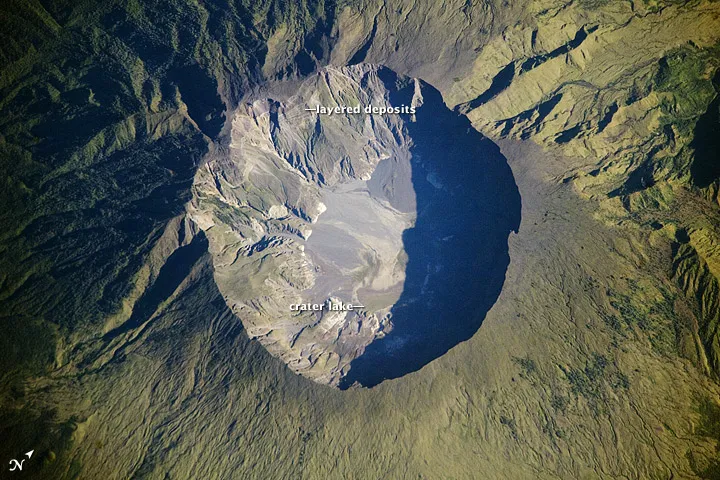
Mount Tambora's 1815 eruption is the largest recorded.
(Image credit: NASA.)
Now, thanks to volcano monitoring, deaths from eruptions have dramatically dropped in recent decades, the report said. But volcano experts are concerned that fatalities could rise in the future, from unmonitored volcanoes; from challenges in evacuating large numbers of people in time; or from giant eruptions like Tambora.
"An eruption of that size today would certainly have major effects on air traffic as well as atmospheric circulation around the globe," Self said.
More than 278,000 people have died in volcanic eruptions since 1600, according to the report. Just five eruptions caused 58 percent of recorded fatalities (this includes Tambora). Of all the deaths, 33 percent were killed by pyroclastic flows and 20 percent by tsunamis; another 14 percent died in lahars. Only 887 people died from lava. Another 24 percent of deaths were indirect, of famine and disease. Ash, avalanches, lightning and other hazards account for the remaining deaths. (Volcanoes can trigger tsunamis from landslides or underwater eruptions.)
Pyroclastic flows are deadly and unpredictable. These flows tumble down the volcano as fast as jet planes, carrying a mix of lethally hot volcanic gas and rock fragments.
Editor's note: This story was updated April 13 to clarify that both island nations and small countries are included in the "most vulnerable" rankings.
Becky Oskin covers Earth science, climate change and space, as well as general science topics. Becky was a science reporter at Live Science and The Pasadena Star-News; she has freelanced for New Scientist and the American Institute of Physics. She earned a master's degree in geology from Caltech, a bachelor's degree from Washington State University, and a graduate certificate in science writing from the University of California, Santa Cruz.