Chilean Volcano Coated in Ash After Eruption, New Images Show

Get the world’s most fascinating discoveries delivered straight to your inbox.
You are now subscribed
Your newsletter sign-up was successful
Want to add more newsletters?
Delivered Daily
Daily Newsletter
Sign up for the latest discoveries, groundbreaking research and fascinating breakthroughs that impact you and the wider world direct to your inbox.
Once a week
Life's Little Mysteries
Feed your curiosity with an exclusive mystery every week, solved with science and delivered direct to your inbox before it's seen anywhere else.
Once a week
How It Works
Sign up to our free science & technology newsletter for your weekly fix of fascinating articles, quick quizzes, amazing images, and more
Delivered daily
Space.com Newsletter
Breaking space news, the latest updates on rocket launches, skywatching events and more!
Once a month
Watch This Space
Sign up to our monthly entertainment newsletter to keep up with all our coverage of the latest sci-fi and space movies, tv shows, games and books.
Once a week
Night Sky This Week
Discover this week's must-see night sky events, moon phases, and stunning astrophotos. Sign up for our skywatching newsletter and explore the universe with us!
Join the club
Get full access to premium articles, exclusive features and a growing list of member rewards.
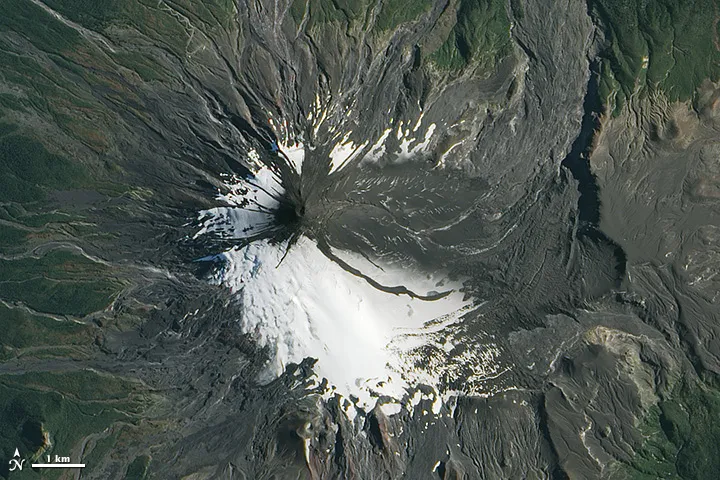
New images of the recent eruption of one of Chile's most active volcanoes reveal how powerful blasts of lava and ash blanketed the mountain's side with volcanic material.
The Villarrica volcano erupted in the early morning hours of March 3, 2015, forcing thousands of people to evacuate the region, according to reports from Chile's National Geology and Mining Service.

Two NASA satellites snapped photos of the volcano, one before and one after the eruption. The advanced Land Imager (ALI) on the EO-1 satellite took one image of the volcano, on Feb. 22, and the Operational Land Imager (OLI) on Landsat 8 took a second photo, on March 5, according to NASA's Earth Observatory.
In the first image, snow surrounds the volcano, but in the second, a large amount of volcanic material, called tephra, coats the volcano's eastern side. [See more images of Villarrica's March eruption]
More than 2,000 people living within the 6-mile-radius (10 kilometers) of Villarrica evacuated as the volcano spewed ash and lava into the sky, according to the Center for Satellite Based Crisis Information. There were concerns that heat from the eruption might melt snow on the volcano and cause mudslides, but no injuries were reported, the center said.
Still, the volcanic ash could pose a health hazard. Meteorologists predict that winds could still blow the ash cloud south and across remote parts of Argentina, the center reported.
Geologists have followed Villarrica's rumblings for more than a month. Researchers recorded increased seismic activity, crater incandescence and explosions throughout February, according to Chile's National Geology and Mining Service. Just before Villarrica's eruption, Jeffrey Johnson, a geophysicist for Boise State University in Idaho living in Chile, planned to evacuate the city of Pucón with his family. But within 30 minutes, the eruption slowed, and Johnson decided to stay. As the blasts subsided, he resumed his work examining low-frequency sounds recorded by dozens of microphones placed around the mountain, according to a statement from NASA's Earth Observatory.
Get the world’s most fascinating discoveries delivered straight to your inbox.
Johnson and his students at Boise State are still analyzing the sounds, and they will continue to monitor the volcano, they said.
Follow Laura Geggel on Twitter @LauraGeggel. Follow Live Science @livescience, Facebook & Google+. Original article on Live Science.

Laura is the managing editor at Live Science. She also runs the archaeology section and the Life's Little Mysteries series. Her work has appeared in The New York Times, Scholastic, Popular Science and Spectrum, a site on autism research. She has won multiple awards from the Society of Professional Journalists and the Washington Newspaper Publishers Association for her reporting at a weekly newspaper near Seattle. Laura holds a bachelor's degree in English literature and psychology from Washington University in St. Louis and a master's degree in science writing from NYU.