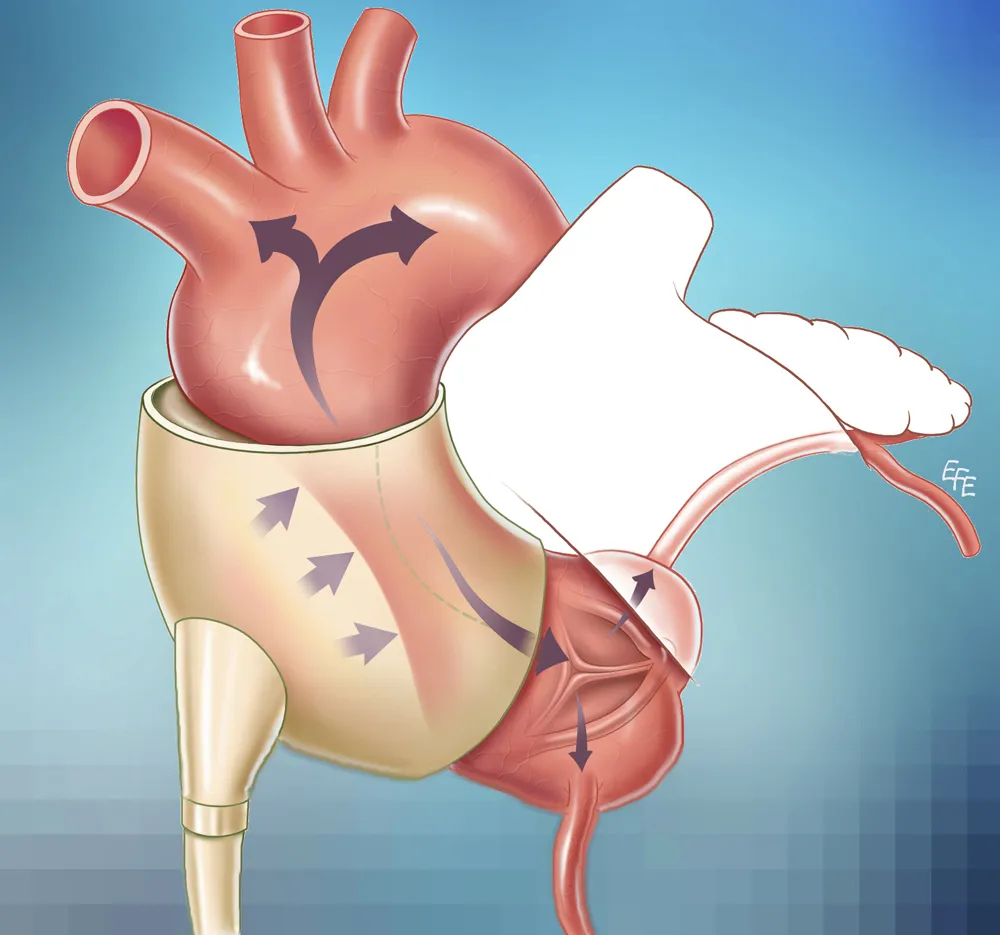
This graphic illustrates a potential breakthrough in the treatment of heart failure patients. The C-Pulse system uses a cuff placed around the aorta and hooked via wires to an external power source. The system is synced with a patient's pulse so that it quickly inflates after each heartbeat to help squeeze blood out of the heart. A new study led by researchers at The Ohio State University Wexner Medical Center showed that the device slowed or reversed symptoms in several heart failure patients during the first round of tests in the United States.
(Image credit: The Ohio State University Wexner Medical Center)
More than 5 million people in the United States have heart failure, one of the fastest-growing forms of heart disease in the nation. Heart failure occurs when the heart muscles can't pump enough blood to meet the body's need for blood and oxygen. While no cure currently exists, there are methods to treat it. The methods we have today, however, aren't always sufficient to manage this disease for some patients.
Now, results from a feasibility clinical trial show that a new investigational medical device made by Sunshine Heart can reduce the work needed to pump blood throughout the body and improve the quality of life for patients with advanced heart failure.
The C-Pulse heart-assist system is a cuff that wraps around the aorta and is powered by a wire that exits the abdomen and connects to an external driver worn by the patient. The driver can be plugged-in or battery-powered. The system synchronizes with a patient's pulse and quickly inflates after each heartbeat, adding pumping force to make it easier for the heart to pump blood throughout the body. This device can be used in combination with current drug therapies.
To test the effectiveness of the device, my team at The Ohio State University Wexner Medical Center took part in a feasibility study of 20 patients with advanced heart failure, funded by Sunshine Heart. Participants were either New York Heart Association (NYHA) functional class III (cardiac disease resulting in marked limitation of physical activity) or ambulatory functional Class IV (cardiac disease resulting in inability to carry on any physical activity without discomfort).
Dr. William Abraham listens to the heart of Richard Jacob at The Ohio State University Wexner Medical Center. Jacob was the first heart failure patient in the United States to test an experimental device known as C-Pulse. Dr. Abraham has authored a new study showing that the device slowed or reversed the symptoms of heart failure in several patients, boosting their stamina and often doubling their quality-of-life scores.
(Image credit: The Ohio State University Wexner Medical Center)
After the device was implanted, the research teams gathered measurements at six months and 12 months. At the one-year mark, standard walking tests showed that the patients had more stamina. Three of the patients had gone from advanced heart failure (NYHA class III and class IV) to showing no symptoms or being mildly symptomatic (class I). For 85 percent of the patients, hospitalizations were eliminated during the 12-month study period.
If you're a topical expert — researcher, business leader, author or innovator — and would like to contribute an op-ed piece, email us here.
Additionally, we saw marked improvement in quality of life. Compared with baseline, patients rated their quality of life nearly 30 points higher after using the C-pulse device. Current drug and device therapies improve the same quality-of-life score by just five to 10 points.
Sign up for the Live Science daily newsletter now
Get the world’s most fascinating discoveries delivered straight to your inbox.
By the end of the study, three "super-responder" participants were weaned from the device altogether. These patients were discontinued from therapy due to improvement. They simply disconnected the pump without having to undergo surgical removal.
Richard Jacob undergoes a six-minute walk test with a nurse at The Ohio State University Wexner Medical Center. Jacob was the first patient in the United States to test an experimental device designed to help heart-failure patients. A new study shows the device, known as C-Pulse, increased stamina in heart failure patients, boosted their quality-of-life scores and significantly reduced their symptoms.
(Image credit: The Ohio State University Wexner Medical Center)
This is an early indication that the C-Pulse may be able to reverse or prevent the progression of heart failure, offering advantages over other treatment options. We are now conducting a randomized, controlled trial of this device, also funded by Sunshine Heart, at many academic medical centers across the country.
Follow all of the Expert Voices issues and debates — and become part of the discussion — on Facebook, Twitter and Google+. The views expressed are those of the author and do not necessarily reflect the views of the publisher. This version of the article was originally published on Live Science.