Rare Sponge Found in Pacific
Get the world’s most fascinating discoveries delivered straight to your inbox.
You are now subscribed
Your newsletter sign-up was successful
Want to add more newsletters?
Delivered Daily
Daily Newsletter
Sign up for the latest discoveries, groundbreaking research and fascinating breakthroughs that impact you and the wider world direct to your inbox.
Once a week
Life's Little Mysteries
Feed your curiosity with an exclusive mystery every week, solved with science and delivered direct to your inbox before it's seen anywhere else.
Once a week
How It Works
Sign up to our free science & technology newsletter for your weekly fix of fascinating articles, quick quizzes, amazing images, and more
Delivered daily
Space.com Newsletter
Breaking space news, the latest updates on rocket launches, skywatching events and more!
Once a month
Watch This Space
Sign up to our monthly entertainment newsletter to keep up with all our coverage of the latest sci-fi and space movies, tv shows, games and books.
Once a week
Night Sky This Week
Discover this week's must-see night sky events, moon phases, and stunning astrophotos. Sign up for our skywatching newsletter and explore the universe with us!
Join the club
Get full access to premium articles, exclusive features and a growing list of member rewards.
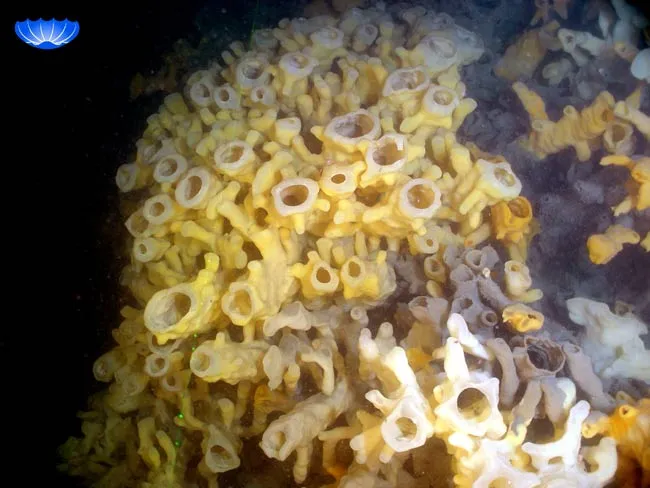
Reef-building glass sponges, thought until recently to be long extinct, have been found off the coast of Washington state, scientists announced yesterday.
Solitary glass sponges, so named because they are made of silica (the same material as beach sand and that is used to make glass), can be found living in many parts of the world's oceans, but they are different species than those that build themselves into reefs.
The three reef-building species were thought to be extinct for 100 million years until they were found a few years ago in protected Canadian waters.
The same three species were recently discovered 30 miles west of Grays Harbor off Washington state, showing that they can also thrive in the open ocean.
The Washington reefs are each hundreds of feet in length and width, and rise between 6 and 15 feet (about 2 to 4.5 meters) above the sea floor.
They host a thriving community of creatures including zooplankton, sardines, crabs, prawns and rockfish in an otherwise sparsely populated stretch of seafloor, said Paul Johnson, of the University of Washington, chief scientist of the expedition that found the reefs.
"It's like looking at an overcrowded aquarium in an expensive Japanese restaurant," he said.
Get the world’s most fascinating discoveries delivered straight to your inbox.
Glass sponges range in color from a creamy white to bright yellow and grow in shapes similar to cups and funnels, unlike other sponges.
Because the newly discovered reefs are in open water and exposed to winter storms, it is likely that other reef-building glass sponges exist in other parts of the ocean, Johnson said.
- Vote: Freaks of Nature
- Images: Colorful Creations
- Life's Little Mysteries


Andrea Thompson is an associate editor at Scientific American, where she covers sustainability, energy and the environment. Prior to that, she was a senior writer covering climate science at Climate Central and a reporter and editor at Live Science, where she primarily covered Earth science and the environment. She holds a graduate degree in science health and environmental reporting from New York University, as well as a bachelor of science and and masters of science in atmospheric chemistry from the Georgia Institute of Technology.