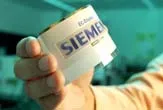
Siemens, a German electronics firm, says that it has lowered production costsfor paper-thin displays sufficiently to allow their use in newspapers and magazines.
Norbert Aschenbrenner of Siemens claimed the new screens can do everything a regular TV screen or computer monitor can do, but at a fraction of the cost:
"The technology makes it possible to put moving images directly onto paper ... at a cost that would make it economical to use on everything from magazines to cigarette packets ... where the moving images would give more detailed instructions than any photo could ever do," he said.
Science fiction fans have already gotten a nice visual foretaste of how the early, small versions of these displays might be used. In the movie Minority Report, Tom Cruise's character has breakfast while watching the moving pictures, text and cartoons on the back of the Pine Oats cereal box.
Bud took a seat and skimmed a mediatron from the coffee table; it looked exactly like a dirty, wrinkled, blank sheet of paper. " 'Annals of Self-Protection,' " he said, loud enough for everyone else in the place to hear him. The logo of his favorite meedfeed coalesced on the page.
(Read more about Neal Stephenson's mediatron)
The earliest reference that I can find to a display screen being used as an updated newspaper is the newspad from the 1968 book version of 2001: A Space Odyssey by Arthur C. Clarke.Other manufacturers and technology firms are working with thin, flexible displays. For examples, see Philips Rollable Display and Philips Readius E-Reader With Rollable Display. See also Paper view technology for more on the work that Siemens is doing; see the picture here. Story found in /. while backtracking link in an interesting discussion about the possiblity of using flexible e-paper displays to create digital wallpaper, thus bringing Ray Bradbury's parlour walls (from the 1953 classic Fahrenheit 451) into reality.
Bill Christensen catalogues the inventions, technology and ideas of science fiction writers at his website, Technovelgy. He is a contributor to Live Science.