In Images: Marine Fossils from an Ancient Mass Die-Off
Get the world’s most fascinating discoveries delivered straight to your inbox.
You are now subscribed
Your newsletter sign-up was successful
Want to add more newsletters?
Delivered Daily
Daily Newsletter
Sign up for the latest discoveries, groundbreaking research and fascinating breakthroughs that impact you and the wider world direct to your inbox.
Once a week
Life's Little Mysteries
Feed your curiosity with an exclusive mystery every week, solved with science and delivered direct to your inbox before it's seen anywhere else.
Once a week
How It Works
Sign up to our free science & technology newsletter for your weekly fix of fascinating articles, quick quizzes, amazing images, and more
Delivered daily
Space.com Newsletter
Breaking space news, the latest updates on rocket launches, skywatching events and more!
Once a month
Watch This Space
Sign up to our monthly entertainment newsletter to keep up with all our coverage of the latest sci-fi and space movies, tv shows, games and books.
Once a week
Night Sky This Week
Discover this week's must-see night sky events, moon phases, and stunning astrophotos. Sign up for our skywatching newsletter and explore the universe with us!
Join the club
Get full access to premium articles, exclusive features and a growing list of member rewards.
Mass stranding
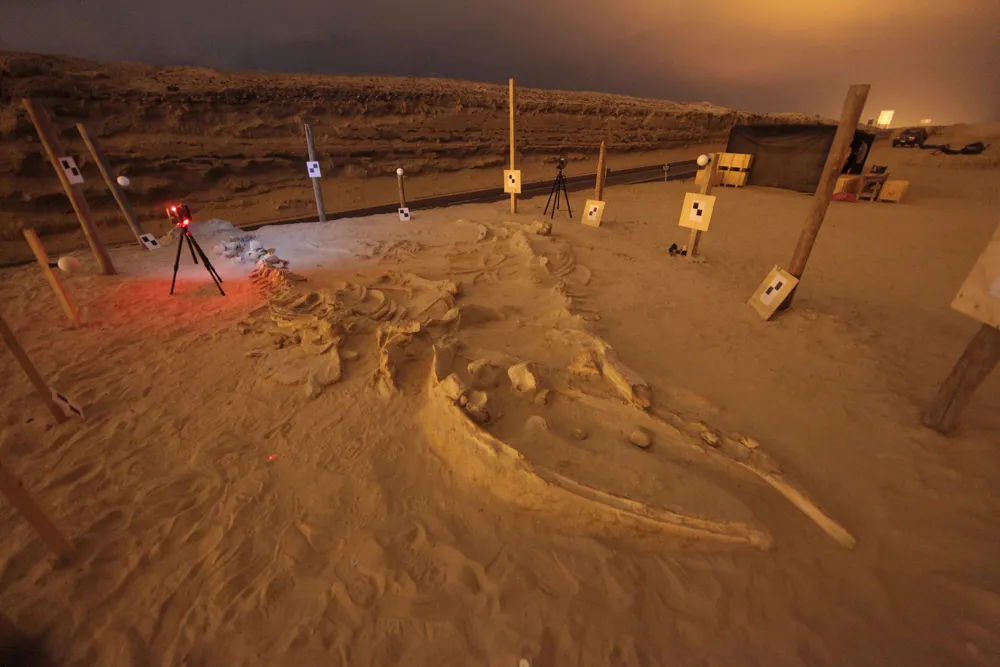
Researchers have discovered dozens of fossilized skeletons of marine animals in what was once an ancient tidal flat in northern Chile. [Read full story]
First of its kind
The piles of bones appear in four distinct layers, suggesting that the animals died in repeated events of what are known as mass strandings. The researchers believe the animals were poisoned to death by harmful algal blooms that produce toxins capable of killing marine life when they accumulate in large quantities. [Read full story]
Road cut
The fossils were discovered in a road cut. [Read full story]
Fossil whales
Whales were the most common animal found within the fossils. [Read full story]
3D scans
The researchers collected 3D scans of the bones to analyze back in the lab. [Read full story]
3D scanning tent
The researchers set up tents to control the lighting for the 3D scans. [Read full story]
Get the world’s most fascinating discoveries delivered straight to your inbox.