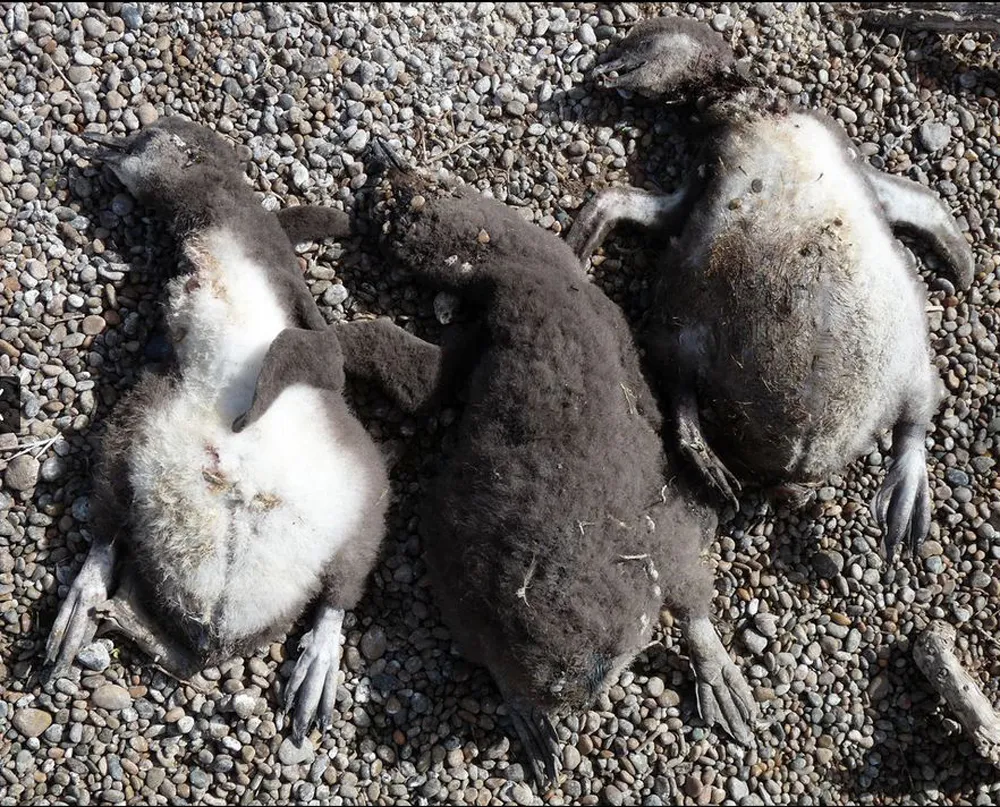
Magellanic penguins are medium-sized penguins that live along the coasts of Chile and Argentina. Researchers based at the University of Washington in Seattle have been monitoring a Magellanic colony located about halfway up the coast of Argentina for nearly 30 years, and have found that mortality rates in chicks have increased in recent years. They attribute this, in part, to increased summer rainstorms which induce hypothermia in young that have not yet developed waterproof plumage, but are too big to seek shelter underneath their parents, as seen in this image.
Wet chick with adult
(Image credit: D. Boersma/U of Washington)
Rainwater has seeped into this chick's down, but runs off the waterproof plumage of its parent.
Wet chick
(Image credit: D. Boersma/U of Washington)
Two chicks in a burrow with a parent. Burrows provide a shelter from rain, but if they are not in a prime location or if they are poorly built, then they can pool with water and become a dangerous place for the chicks.
Laura Poppick is a contributing writer for Live Science, with a focus on earth and environmental news. Laura has a graduate certificate in science communication from the University of California, Santa Cruz, and a Bachelor of Science degree in geology from Bates College in Lewiston, Maine. Laura has a good eye for finding fossils in unlikely places, will pull over to examine sedimentary layers in highway roadcuts, and has gone swimming in the Arctic Ocean.