













Earth-Friendly Packaging Made of Organic Mushroom Parts
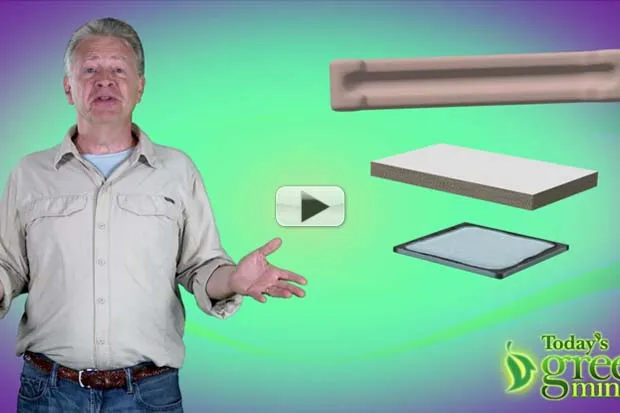
Most of today's gadgets and gizmos are packed with plastic and Styrofoam that take eons to decompose. On top of that, these packing materials are often derived from petroleum. But an innovative company is trying to change that with a little help from a common pizza topping: mushrooms.
Biomaterials company Ecovative Design figured out a way to create protective packaging, insulation and ceiling tiles that are made without using petroleum and decompose after use. This eliminates pollution and waste at nearly every part of the plastics supply chain.
How do they do it? First, agricultural waste like cornhusks and cottonseed hulls are ground up and mixed with mycelium, the root systems of mushrooms. The mixture is then poured into a mold and left to sit in the dark for a few days. The mycelium spreads throughout the mixture, binding it together in a strong web just like it would in soil.
Customers won’t have to fret about receiving a moldy plasma TV because the final step is to bake the now-solid mushroom material, stopping the growth process. The end result is a completely biodegradable packing material that is safe to chuck in your garden or compost pile.
The process may seem a little crazy at first, and that’s just what some of Eben Bayer and Gavin McIntyre’s fellow students at Rensselaer Polytechnic Institute thought, too. But their professor encouraged them to continue their research, setting up shop in in Rennselaer’s Business Incubator after graduating.
Bayer and McIntyre soon co-founded Ecovative Design and focused on creating mycelium-based wall insulation, but in 2009, they shifted their attention to launching mushroom packaging commercially. By 2011, the packaging was being used by companies like Dell and Crate & Barrel, replacing thousands of plastic foam packing parts that would have otherwise ended up in the garbage.
Today, the material has won Ecovative a host of awards, including the Environmental Protection Agency’s Environmental Quality Award and Richard Branson’s Screw Business as Usual Award.
Get the world’s most fascinating discoveries delivered straight to your inbox.
Follow LiveScience @livescience, Facebook & Google+.