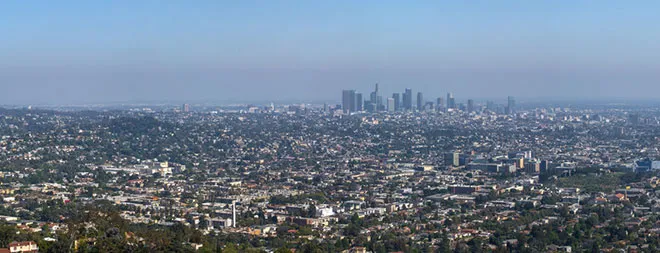
(ISNS) -- Cities are made up of multitudes of people who by and large act independently of each other. As such, one might expect the behavior of cities themselves to appear random. It turns out, however, that cities act as cohesive entities that display identifiable patterns of behavior. Scientists find the growth of a city apparently can be predicted from its past and influence how neighboring cities grow.
The majority of people worldwide now live in cities. Although cities are society's chief engines of innovation and the creation of wealth, they are also its main source of crime, pollution and disease. These factors, combined with how cities continue to expand in both size and number across the globe, are leading researchers to investigate how cities work. The data and insights they develop about such behavior of cities may help researchers learn more about the future of humanity.
"We have learned that a group even as big as millions of people behaves as a coherent entity," said Alberto Hernando, a physicist at the Federal Polytechnic School of Lausanne in Switzerland. "Millions of individual free and unpredictable decisions generate a collective outcome that follows fundamental laws and principles."
Latest Videos From
Predicting how cities might act is a great challenge, since their behavior is likely based on millions of decisions with any number of economic, political, rational, emotional and other motives. To decipher the rules that cities may follow, Hernando and his colleagues analyzed more than a century's worth of data — records from the National Statistics Institute of Spain on the populations of 8,100 municipalities from 1900 to 2011, currently totaling more than 45 million people spread out over about 193,000 square miles.
After investigating Spanish city growth rates over space and time, the scientists discovered the rates of population growth in Spanish cities followed cycles about 15 years long on average.
"A kind of memory is present in them," Hernando said. "Cities are complex objects with many surprises inside."
In addition, they found that cities interacted with each other. The rate at which a city grew influenced the growth rates of other cities within about 50 miles from it on average.
These findings could help forecast how populations might change and migrate in the future, "which can help economic and political decision-making," Hernando said. Researchers could also model population flow, testing the consequences of various hypothetical situations "in a kind of virtual simulation of the particular country," he added.
The researchers noted that their findings reflect how Spanish cities behaved on average. Specific cities might differ — for instance, geographic or economic factors such as highways and rail systems "may influence how a city interacts with its neighbors," Hernando said.
The researchers are now analyzing databases of other countries and continents as well, "to specify which behaviors are universal to humans and which ones are local," Hernando said. "We are also extending our mathematical framework to include the dynamics of economic entities such as firms and companies."
Much work still needs to be done to uncover the mechanisms underlying these patterns — "how one gets these time and spatial scales," said physicist Luis Bettencourt at the Santa Fe Institute in New Mexico, who did not take part in this study. "This has been a bit of a mystery, and the models that we do have, while fitting the data, are just models, with no root in human behavior. We would like to have models that start with people's micro-behavior and extract these large-scale results."
The single most important lesson to take from the study, according to Bettencort, is that change on a macro scale requires consistent action over a long period of time – much longer than most political terms.
"This means that urban policies need to be thought of on such timescales, not on four-year terms or other political timescales," said Bettencort.
"I think we need to understand systems of cities in terms of flows between them — of people, information, goods," Bettencourt said. "If we know what is being exchanged between any pair of cities, we can write the equations for the evolution of the system of cities, the nation and beyond, as a whole."
The scientists detailed their findings online Nov. 20 in the Journal of the Royal Society Interface.
Inside Science News Service is supported by the American Institute of Physics. Charles Q. Choi is a freelance science writer based in New York City who has written for The New York Times, Scientific American, Wired, Science, Nature, and many other news outlets. He tweets at @cqchoi.