It's quick and easy to access Live Science Plus, simply enter your email below. We'll send you a confirmation and sign you up for our daily newsletter, keeping you up to date with the latest science news.
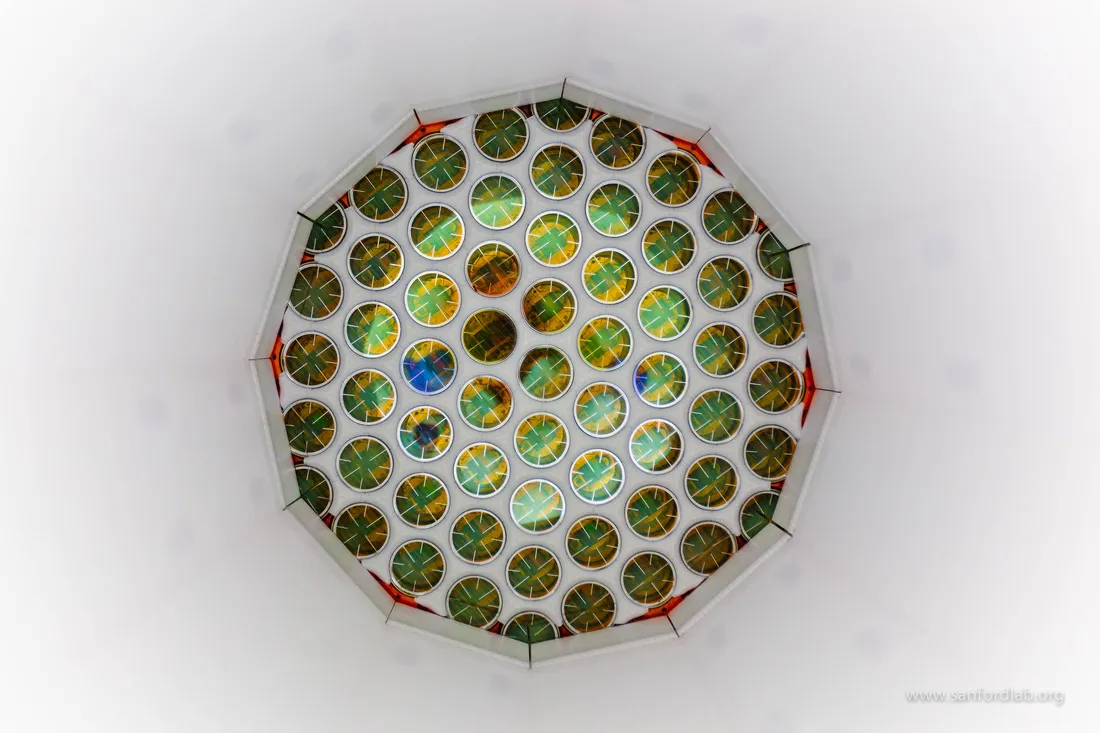
An artist illustration showing the view from inside the Large Underground Xenon (LUX) dark matter detector buried deep below the Black Hills of South Dakota. Image released Oct. 30, 2013.
A new experiment buried deep underground has proven itself to be the most sensitive dark-matter detector ever built. But the first results from the high-tech instrument have turned up empty in its search for elusive dark matter, scientists announced today (Oct. 30).
Housed 1 mile (1.6 kilometers) underground in the Black Hills of South Dakota, the Large Underground Xenon (LUX) experiment's sensitivity makes it better at seeking out dark matter than any other detectors built for that purpose, LUX officials said. Although the powerful dark matter detector has just completed its first run, LUX has not yet found conclusive evidence of the elusive substance.
"The universe's mysterious dark sector presents us with two of the most thrilling challenges in all of physics," Saul Perlmutter, of the Lawrence Berkeley National Laboratory and a winner of the 2011 Nobel Prize in physics, said in a statement. "We call it the dark sector precisely because we don't know what accounts for most of the energy and mass in the universe. Dark energy is one challenge, and as for the other, the LUX experiment's first data now take the lead in the hunt for the dark-matter component of the dark sector." [Photos: Dark Matter Throughout The Universe]
Astronomers know more about what dark matter is not than what it actually is.
(Image credit: Karl Tate, SPACE.com Infographics Artist)
Scientists think that dark matter makes up the majority of the matter in the universe; however, it cannot be seen or touched. Astronomers detect dark matter because they have seen its gravitational pull on galaxies and stars.
By running experiments like LUX far underground, scientists hope to shield the dark-matter detector from everything but WIMPs — weakly interacting massive particles that are thought to be the leading candidates for the particles that make up dark matter.
"LUX is the quietest place verified in the world," Rick Gaitskell, a Brown University physicist, said during a seminar today (Oct. 30). "That's how far we've had to go in order to be in a position to look for these WIMPs."
LUX is particularly adept at searching for low-mass WIMPs, which are predicted by some theoretical physics models. WIMPS are extremely difficult to find because they rarely interact with ordinary matter, except through gravity, LUX officials said.
Sign up for the Live Science daily newsletter now
Get the world’s most fascinating discoveries delivered straight to your inbox.
Scientists think that WIMPs can be both low-mass and high-mass, and LUX has an enhanced sensitivity to low-mass WIMPs. The dark-matter detector recently completed its first data-collecting research run.
Through the course of the approximately three-month WIMP search, scientists did not find signals of WIMPs, although previous experiments with other detectors predicted that they would.
"Three candidate WIMP events recently reported in ultracold silicon detectors, however, would have produced more than 1,600 events in LUX's much larger detector, or one every 80 minutes in the recent run," LUX officials said in a statement. "No such signals were seen."
LUX houses a 6-foot-tall (1.8 meters) titanium tank filled with liquid xenon and cooled to minus 150 degrees Fahrenheit (minus 101 degrees Celsius). The xenon tank is surrounded by rock and a tank of water.
If a WIMP comes into contact with a xenon atom, it will emit light and electrons. The electrons are pulled upward and release more photons. By recording both the photons at the collision point and at the top of the tank, the detector is able to pinpoint the locations of the photon signals and measure their brightness.
Miriam Kramer joined Space.com as a staff writer in December 2012. Since then, she has floated in weightlessness on a zero-gravity flight, felt the pull of 4-Gs in a trainer aircraft and watched rockets soar into space from Florida and Virginia. She also serves as Space.com's lead space entertainment reporter, and enjoys all aspects of space news, astronomy and commercial spaceflight. Miriam has also presented space stories during live interviews with Fox News and other TV and radio outlets. She originally hails from Knoxville, Tennessee where she and her family would take trips to dark spots on the outskirts of town to watch meteor showers every year. She loves to travel and one day hopes to see the northern lights in person.