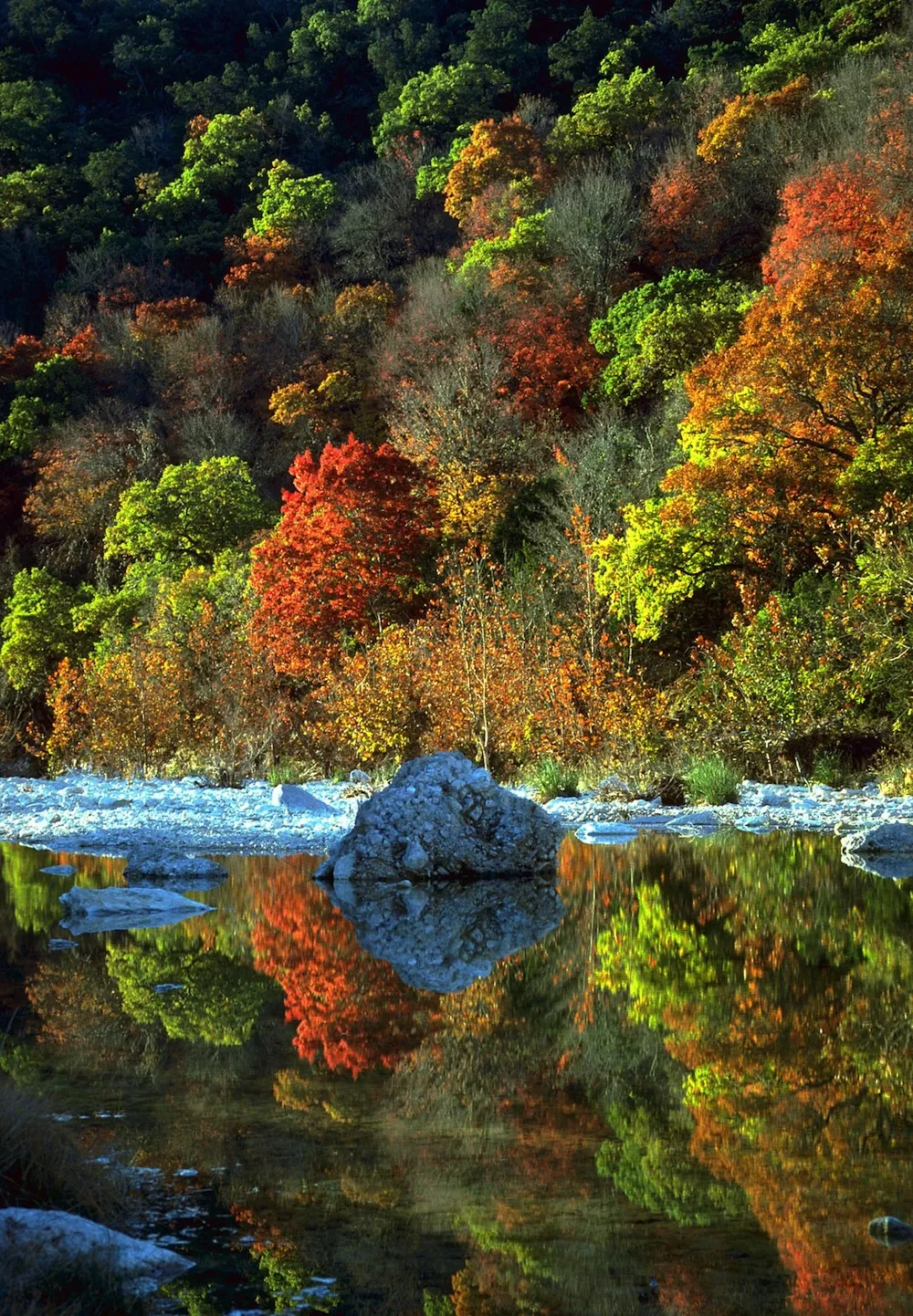
Leaf-peeping season is in full swing, but the federal government shutdown has shuttered the country's national parks, closing off some of the prime areas for checking out autumn's riotous colors. Luckily state parks and other natural areas boasting fall's leaves are still accessible.
As soon as the government shutdown began on Oct. 1, the entrances to national parks were closed off with signs reading, "Because of the federal government shutdown, this National Park Service Facility is closed." In other words, the leaves are off limits from Rocky Mountain National Park in Colorado to Acadia National Park in Maine.
But there's some good news: Plenty of state parks around the country whose foliage is sight to behold are open for visitors. Here, we've listed a few spots you can hit to see those gorgeous red, orange and yellow hues.
Let's start in the part of the country perhaps most synonymous with fall foliage: New England. This region is awash in fall colors at this time of year — the hues are even clear from space! So you're fairly well guaranteed of a great show wherever you go, but here's one state park you can check out:
Monadnock State Park, N.H.
The 1,000 acres of New Hampshire's Monadnock State Park include the 3,165-foot-high (965 meters) Mount Monadnock, a magnet for hikers (the park's website says it is the third most climbed mountain in the world). [Leaf Peeper Paradise: Autumn's Best Colors]
The area is currently at 80 percent of its peak fall color, according to New Hampshire's tourism website, with the best bets for amazing views in upland areas where sugar maples are a riot of yellow and orange.
Sign up for the Live Science daily newsletter now
Get the world’s most fascinating discoveries delivered straight to your inbox.
The Midwest has its fair share of leafy splendor too, and right now, Wisconsin is ablaze with color. And if you want to see more than just the leaves, taking a driving tour of Marinette Countys waterfalls is a good bet for a pretty view.
The 125-mile-loop (200 kilometers) features a series of 14 falls and cataracts, all surrounded by a blaze of autumnal color. The area is open to hiking, camping, picnicking and whitewater rafting. The area is currently at 85 percent of its peak, with the full peak expected in the third week of October, according to Wisconsin's tourism site.
Texas may conjure images of prairies and sun-bleached terrain, but about 70 miles (about 110 kilometers) west of San Antonio sits a leaf-peeping paradise: the Lost Maples State Natural Area.
The 2,174-acre park is part of the Edwards Plateau and features steep limestone canyons, grassland and a large stand of Uvalde bigtooth maples, which are responsible for the vibrant fall show of yellow and scorching red.
The southerly location of the trees means their leaves turn later than those up north, with the maples typically putting on their fall colors from late October to early November. Lost Maples is a big draw for the area in the fall, and its website suggests a weekday trip to avoid the crowds.
Despite its reputation for gray, gloomy days, the Pacific Northwest sees its share of brilliant fall leaves. One scenic spot near the town of Rainbow in western Oregon is the King-Castle Trail, which winds for 2 miles up through the forest, ending along an abandoned logging road that offers a stunning view of the triplet of volcanic peaks known as the Three Sisters, according to Oregon Lakes & Rivers.
Andrea Thompson is an associate editor at Scientific American, where she covers sustainability, energy and the environment. Prior to that, she was a senior writer covering climate science at Climate Central and a reporter and editor at Live Science, where she primarily covered Earth science and the environment. She holds a graduate degree in science health and environmental reporting from New York University, as well as a bachelor of science and and masters of science in atmospheric chemistry from the Georgia Institute of Technology.