













Fusion Experiments Inch Closer To Break-Even Goal

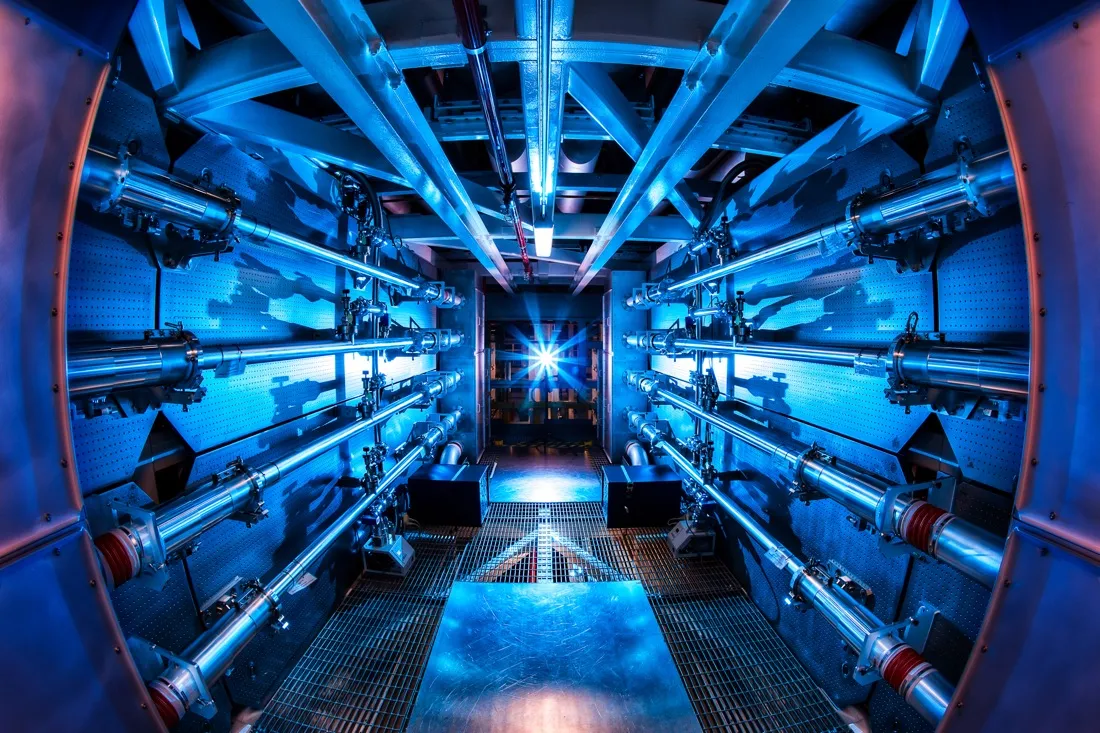
Fusion energy has proven an elusive goal — a running joke is that humanity is 20 years away from a practical power plant, and has been for 60 years.
That could be changing, said John Edwards, associate director for inertial confinement fusion and high-energy-density science of the National Ignition Facility.
In a recent piece published in the journal Physics of Plasmas, Edwards said NIF scientists are getting closer to reactions that produce more energy than they need to get going, and added that the obstacles to realizing nuclear fusion involve engineering problems rather than basic physics.
Fusion energy harnesses the same power source that makes the sun shine. It involves pushing together atomic nuclei— the protons and neutrons of atoms — to form heavier elements and release energy. In stars like the sun, fusion occurs due to the immense weight of hydrogen gas that crushes together the protons at the sun's center to make helium. Fusion differs from fission reactions, used in current nuclear power plants, where an atom spontaneously breaks up — the process of radioactive decay — and releases energy. [Science Fact or Fiction? The Plausibility of 10 Sci-Fi Concepts]
Unlike the radioactive byproducts of fission, fusion power plants promise a lot of energy with no radioactive waste; in many fusion reactions, the product is helium.
Making energy?
To create fusion reactions, the NIF scientists fire lasers into a hohlraum, or a hollow cylinder made of gold. The laser pulses, lasting billionths of a second, hit a tiny sphere that is full of deuterium (hydrogen with an extra neutron) and tritium (hydrogen with two extra neutrons).
Get the world’s most fascinating discoveries delivered straight to your inbox.
As the laser beams hit the hohlraum, the gold emits X-rays that are so powerful they vaporize the metal surface of the sphere. That vaporization puts immense pressure on the deuterium and tritium, and induces fusion, smashing the hydrogen atoms into helium, plus one neutron.
The problem is that even tiny imperfections in the surface of the sphere will mean the pressure on the deuterium and tritium isn't perfectly even all the way around. Result? "It implodes like a porcupine," Edwards told LiveScience. This uneven "reverse explosion" results in energy waste so that more energy is put into the system than comes out of it.
But, to get better implosions, the NIF team figured out how to reduce the effect. It meant changing the shape of the laser pulses to vary the amount of energy carried in them over time. Edwards' group found that by altering the shape in a different way than before, and making the pulses shorter — 10 nanoseconds instead of 15 nanoseconds — they were able to make the spheres implode more evenly.
That got the NIF closer to the "scientific break-even point," where the amount of energy that comes out of the fusion reaction is equal to that which was put in by the kinetic energy from the implosion. (The energy from the laser isn't counted in the calculation). Right now, the amount of energy coming out of the NIF setup is about 80 percent of what is put in.
There will be more experiments, aimed at fine-tuning the implosion, Edwards said.
None of this is going to result in a fusion-based power plant. But Edwards noted that isn't really the point — at least not yet. In part, the goal is to find a way to control the implosions necessary to get self-sustaining fusion reactions to work.
"NIF is built to ignite a fusion pellet," said Stewart Prager, director of the Princeton Plasma Physics Laboratory. "They didn't get it by the time they originally stated, but they are making progress." The NIF was built in 2008; its original mandate was to achieve ignition — the break-even point — in 2012.
The future of fusion
Edwards also noted the physics, at least, is working the way the computer simulations and theories say it will. That points to an engineering problem, rather than any need for new physical theories to describe what is happening inside the spheres. [The 9 Biggest Unsolved Mysteries in Physics]
There are other methods of creating fusion reactions. The best-known method, called tokamak, uses magnetic fields to confine plasma, or gas heated to millions of degrees. The International Thermonuclear Experimental Reactor, or ITER, being built in southern France, will examine this technique. Dozens of experimental fusion reactors have been built over the years; but they are designed for research, not as power plants. ITER will be the first designed to generate self-sustaining reactions, but it won't even start the first real-world experiments until the 2020s.
Which brings us to the big criticism of fusion experiments — that they won't yield anything useful in a reasonable timeframe. Both the NIF and ITER are pricey: The NIF is a $3.5 billion project, whereas ITER is projected to cost about $17.5 billion. Fusion research generally has been conducted since the 1960s.
There are also still technical hurdles even if the NIF achieves ignition. The fusion reactions NIF is investigating all produce neutrons. Neutrons, which don't have an electrical charge, can pass through any material that's not properly shielded. But when they hit other atoms, they can break them up, or make whatever material they hit radioactive; they can even weaken metals. That means in order to fulfill the promise of eliminating radioactivity, the fusion reactions can't involve neutron fusion, as happens for deuterium and tritium. On the other hand, the neutrons might be a source of extra energy — at least one fusion reactor design makes use of fluoride salts of boron and lithium to shield the reactor walls from the neutrons, and carry away their heat — which could be used to drive turbines with steam.
François Waelbroeck, director of the Institute for Fusion Studies at the University of Texas, said that even though there are problems with deuterium-tritium fusion — the type being studied now — the idea is that once scientists learn to make that reaction work, they can move on to reactions that don't emit neutrons. Such reactions involve lithium or boron.
Some smaller companies are also engaged in fusion power research — one called EMC2 has received funding from the U.S. Navy for its research, though it hasn't published the results in peer-reviewed journals. Others such as Tri-Alpha Energy, General Fusion and Lawrenceville Plasma Physics have also run various experiments, though no company has built anything like a working plant or achieved self-sustaining reactions. All of the companies focus on fusion reactions that don't generate neutrons.
Still, Edwards is optimistic. "Our goal is to demonstrate that ignition is feasible," he said. "We've made a huge amount of progress, and we're close to achieving what our calculations say should be happening in a regime slightly less demanding than full-up ignition implosions."
Follow LiveScience @livescience, Facebook & Google+. Original article on LiveScience.
