













By Accident, Researchers Set World Record for Thinnest Glass

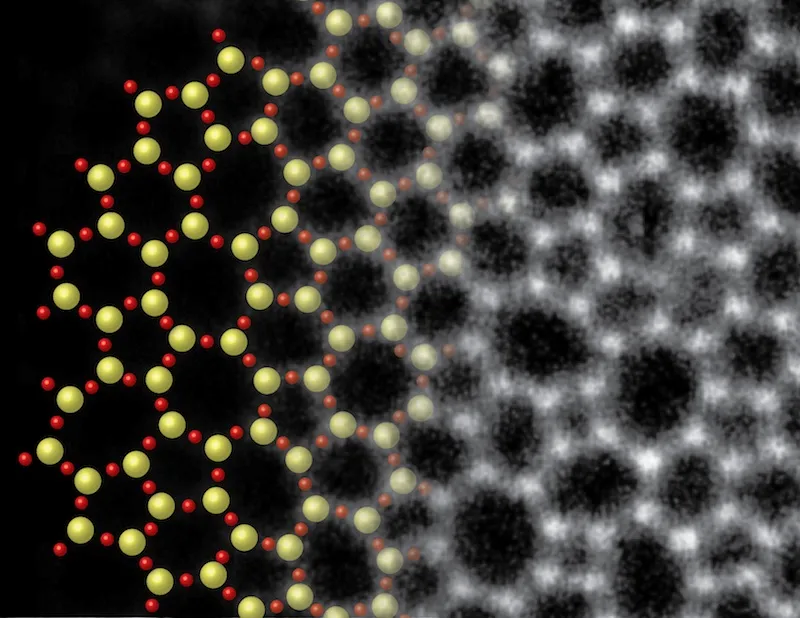
Researchers accidentally discovered the world's thinnest sheet of glass, just two atoms thick.
Their chance finding — now immortalized in the 2014 edition of the Guinness Book of World Records, out this week — gives scientists a glimpse into the puzzling properties of glass, which behaves like both a solid and a liquid.
Researchers at Cornell University and Germany's University of Ulm were creating graphene, one of the thinnest and strongest materials in the world. Sheets of graphene are just one carbon atom thick, with those atoms arranged in a honeycomb lattice. [Gallery of Wonders: The Weirdest World Records]
Using an electron microscope, the researchers inspected some "muck" on the graphene, finding that it was essentially a 2D sheet of common glass, made up of silicon and oxygen atoms.
The glass layer likely was created when an air leak caused copper foils, which are involved in the graphene-making process, to react with a furnace made up quartz, a mineral that is comprised of silicon and oxygen, the researchers say.
The researchers' observations were first described in January 2012 in the journal Nano Letters. They say their microscopic photos of the ultra-thin pane may help to solve some long-standing uncertainties about glass, which is not exactly a liquid or a solid.
Most solids when they cool arrange their atoms in a rigid lattice. Though glass is hard and has a solid appearance, atoms that make up glass are arranged in a disordered network, more like a liquid.
Get the world’s most fascinating discoveries delivered straight to your inbox.
The structure of the 2D glass that the Cornell researchers saw is similar to theoretical models of the irregular structure of glass dating back to the 1930s.
"This is the work that, when I look back at my career, I will be most proud of," David Muller, professor of applied and engineering physics at Cornell, said in a statement. "It's the first time that anyone has been able to see the arrangement of atoms in a glass."
Though it was an accidental discovery, the researchers say such deliberately created 2D glass could find its way into nanotechnology and could even one day be used in transistors.
Follow Megan Gannon on Twitter and Google+. Follow us @livescience, Facebook & Google+. Original article on LiveScience.
