














Geology in the City: Central Park Photos

Central Park Rocks

Despite impressive landscaping efforts over the last two centuries, New York's Central Park has retained natural features that took thousands of years to form. The urban oasis, which covers some 840 acres (339 hectares), is a great place to see layers of ancient bedrock jutting out from the grass or glacial grooves on a schist surface.
Glacial Grooves

During the last ice age, glaciers dragged rocks across the surface of Manhattan's bedrock, leaving behind the groves and striations that can be seen in Central Park today.
Manhattan Schist
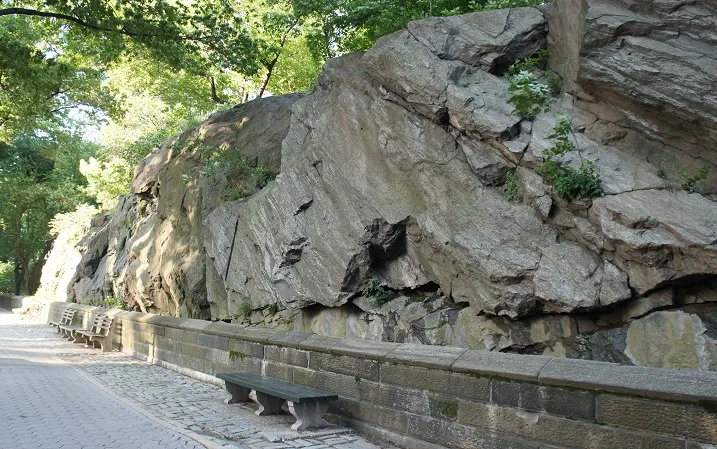
This cross-section of bedrock on Central Park West shows how the layers of Manhattan schist are tilted to the south.
Rocks Point the Way

If you are having trouble orienting yourself in the park, the southerly dipping rock layers could point you in the right direction.
Mica Specs

Glinting flecks of mica can been seen in the schist.
Limestone

Even many of the manmade parts of Central Park have a geologic history. The window dressings on this building are made from Indiana limestone, which formed at the bottom of a shallow inland sea that covered most of the Midwestern United States during the Mississippian period. Tiny marine fossils sometimes can be spotted on structures built with this material.
Cleopatra's Needle

Cleopatra's Needle may be Central Park's oldest manmade feature, but it has a geologic history that predates even the ancient Egyptians. It is carved from Aswan granite that formed some 600 million years earlier.
Get the world’s most fascinating discoveries delivered straight to your inbox.
Sidney Horenstein

Sidney Horenstein, a geologist and environment educator emeritus at the American Museum of Natural History, gives walking tours in New York.
