













'Britishisms' Creeping into American English

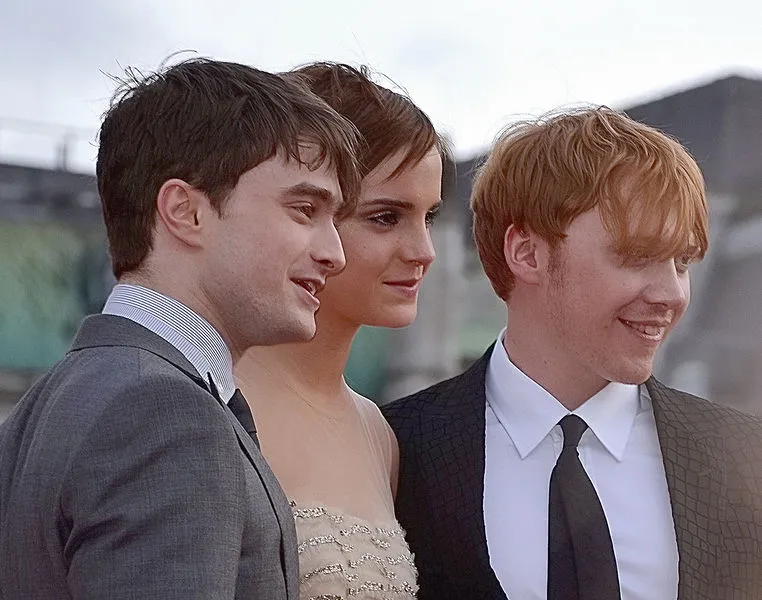
British people have long bemoaned the gradual encroachment of Americanisms into everyday speech, via Hollywood films and sitcoms. Now, "Britishisms" are crossing the pond the other way, thanks to the growing online popularity of British media such as Harry Potter, Downton Abbey and The Daily Mail.
For example, BBC News reports that "ginger" as a descriptor of a red-haired, freckly person has shot up in usage in the United States since 1998. That's the year the first Harry Potter book, with its Weasley family of gingers, hit store shelves. The trend shows up in Google ngram searches, which track the frequency of words and phrases appearing in print.
The Britishism invasion also includes "cheeky," "twee," "chat-up," "sell-by date" and "the long game," as well as "do the washing up," "keen on," "bit" (as in "the best bit"), "to book" (e.g. a flight), "called X" (instead of "named X") and "to move house."
A few of these now sound so familiar to American ears that their recent limey origins might come as a surprise. [Why Do Americans and Brits Have Different Accents?]
While some of these British terms have gained ground because they sound pleasantly posh to American ears, Jesse Sheidlower, American editor-at-large of the Oxford English Dictionary, says others simply fill a gap where there is no equivalent in American English. "One-off," as in something which is done, or made, or which happens only once, and "go missing," instead of the vaguer "disappear," are two examples.
According to Sheidlower, the small but noticeable increase in the American usage of traditionally British terms doesn't bother Americans nearly as much as Americanisms bother many Brits.
"In the U.K., the use of Americanisms is seen as a sign that culture is going to hell," he told BBC News. "But Americans think all British people are posh, so — aside from things that are fairly pretentious — no-one would mind."
Get the world’s most fascinating discoveries delivered straight to your inbox.
This laissez-faire linguistic attitude hasn't always been the American way. Early in U.S. history, when the nation was striving to distinguish itself from its former landlords, the dictionary maker Noah Webster set about establishing a distinctly American form of English. Webster's legacy includes the lack of "u" in words like "color" and the "-er" ending in words like "center" — spelling variants he viewed as superior to their British counterparts (colour and centre).
Some of the economical spellings Webster adopted, such as "public" instead of the British "publick," have since spread back to England. Clearly, in the continuously evolving languages of these transatlantic allies, there is give and take.
Follow Natalie Wolchover on Twitter @nattyover or Life's Little Mysteries @llmysteries. We're also on Facebook & Google+.

Natalie Wolchover was a staff writer for Live Science from 2010 to 2012 and is currently a senior physics writer and editor for Quanta Magazine. She holds a bachelor's degree in physics from Tufts University and has studied physics at the University of California, Berkeley. Along with the staff of Quanta, Wolchover won the 2022 Pulitzer Prize for explanatory writing for her work on the building of the James Webb Space Telescope. Her work has also appeared in the The Best American Science and Nature Writing and The Best Writing on Mathematics, Nature, The New Yorker and Popular Science. She was the 2016 winner of the Evert Clark/Seth Payne Award, an annual prize for young science journalists, as well as the winner of the 2017 Science Communication Award for the American Institute of Physics.