













Experiment Investigates How to Fight Fire in Space

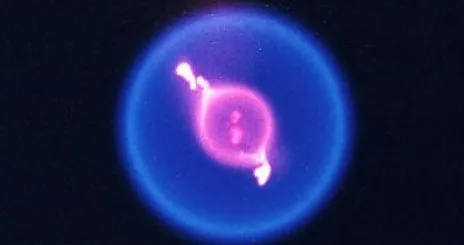
New experiments on the International Space Station may reveal tips on fighting fires in space, and back here on Earth, too.
In space, where there is no up or down, and the atmosphere and pressure within the closed confines of a spacecraft are tightly controlled, fire burns differently. The Flame Extinguishment Experiment, known as FLEX, aims to better understand how.
For example, in the weightless environment of orbit, flames can burn at a lower temperature and require less oxygen to ignite than they do in normal gravity. Thus, fire extinguishers in space must use more-concentrated material.
Another difference is that a flame around a droplet of fuel in space can be completely spherical, while that is very different to achieve on the ground. And this spherical symmetry makes it easier to observe droplets' behavior and to craft the calculations that explain it, the study's leader, University of California, San Diego, aerospace engineering professor Forman Williams, said in a statement.
While the experiments are floating more than 200 miles above Earth, they are controlled remotely from NASA's John Glenn Research Center in Cleveland, Ohio. The project is lodged inside a chamber on the International Space Station's Destiny module, and is equipped with sensors and video cameras to record the action.
Inside the chamber, small drops of chemicals such as heptane or methanol are set on fire, and burn for about 20 seconds. A device called the Multiuser Droplet Combustion Apparatus is used to ignite the droplets in various atmospheric conditions.
The first round of these experiments ran from March 2009 to December 2011. A second round, scheduled to last at least a year, began in January. [6 Cool Space Shuttle Science Experiments]
Get the world’s most fascinating discoveries delivered straight to your inbox.
"Research leads to a better understanding of fire behavior," Willams said. "And better understanding ultimately leads to better safety designs."
The new phase of the study aims to use the space environment to recreate conditions inside a combustion engine.
"Findings could lead to new designs for cleaner fuels that have a smaller carbon footprint and emit fewer pollutants, among other applications," according to a University of California, San Diego, statement.
Williams' interest in fire first ignited when he was a college student at Princeton and a professor wrote the conservation equations of combustion on a blackboard.
"When I realized how complicated they were, I said to myself that there is enough there to last me a lifetime," Williams said.
Williams and his colleagues plan to present the results from the first round of FLEX this summer at a symposium in Poland.
Follow SPACE.com for the latest in space science and exploration news on Twitter @Spacedotcom and on Facebook.
