













Space Might Be Like a Chessboard, Particles Like Pawns

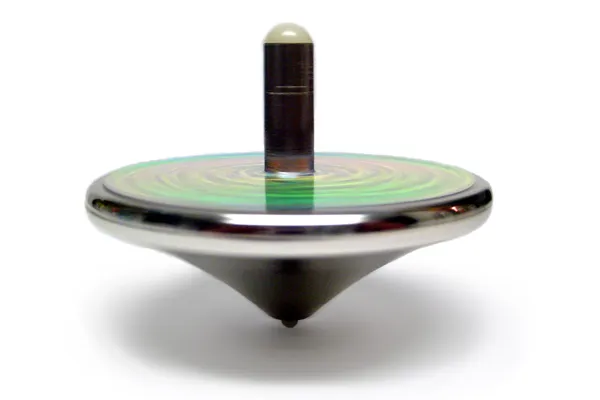
Electrons have an inherent property called spin, and are either "spin up" or "spin down." Loosely speaking, they can be thought of as tops rotating either one way or the other, but not both ways. The two electron spin states are what make matter stable, govern chemical bonding, produce magnetic fields and define many other aspects of nature.
But the problem is, electrons can't actually spin. To rotate, they would have to have spatial extent and a radius, but physicists consider the particles to be infinitely small points. Despite their importance, what "spin up" and "spin down" physically mean is a total mystery.
Now, two UCLA physicists think they have a clue. "An electron's spin might arise because space at very small distances is not smooth, but rather segmented, like a chessboard," lead researcher Chris Regan said in a press release. If space has discrete segments of two types, like the black and white tiles of a chessboard, it could imbue the particles within it with two states of spin, the researchers found.
Regan, with his graduate student Michael Mecklenburg, came to this conclusion by studying the behavior of electrons as they move through graphene, an extremely strong, two-dimensional honeycomb lattice of carbon atoms. The space in and around the carbon atoms can be one of two types, depending on how light interacts with it. This creates a grid of light and dark "tiles" like the squares on a chessboard.
Electrons move through the graphene by hopping from tile to tile, and depending on whether they are on a light or dark tile, they behave as if they are either "spin up" or "spin down." In this case, spin, which the researchers also call "pseudospin," isn't the same as the inherent spin of electrons as they move through space. It's a spin property unique to electrons in graphene.
Still, the results show that spin can emerge from confining electrons to a lattice. "It makes you wonder if the usual electron spin could be generated in the same way," said Mecklenberg. Regan added, "It would be odd if graphene's honeycomb structure was the only lattice capable of generating spin."
In short, spin, they explain in their March 18 paper in Physical Review Letters, "can derive from hidden substructure, not of the particles themselves, but rather of the space in which these particles live."
Get the world’s most fascinating discoveries delivered straight to your inbox.
- Where Do Electrons Get the Energy to Spin Around an Atoms' Nucleus?
- What's at the Center of Black Holes?
- What is Relativity?
Got a question? Send us an emailThis e-mail address is being protected from spambots. You need JavaScript enabled to view it This e-mail address is being protected from spambots. You need JavaScript enabled to view it This e-mail address is being protected from spambots. You need JavaScript enabled to view it This e-mail address is being protected from spambots. You need JavaScript enabled to view it This e-mail address is being protected from spambots. You need JavaScript enabled to view it This e-mail address is being protected from spambots. You need JavaScript enabled to view it This e-mail address is being protected from spambots. You need JavaScript enabled to view it This e-mail address is being protected from spambots. You need JavaScript enabled to view it This e-mail address is being protected from spambots. You need JavaScript enabled to view it This e-mail address is being protected from spambots. You need JavaScript enabled to view it This e-mail address is being protected from spambots. You need JavaScript enabled to view it This e-mail address is being protected from spambots. You need JavaScript enabled to view it This e-mail address is being protected from spambots. You need JavaScript enabled to view it This e-mail address is being protected from spambots. You need JavaScript enabled to view it This e-mail address is being protected from spambots. You need JavaScript enabled to view it This e-mail address is being protected from spambots. You need JavaScript enabled to view it This e-mail address is being protected from spambots. You need JavaScript enabled to view it This e-mail address is being protected from spambots. You need JavaScript enabled to view it This e-mail address is being protected from spambots. You need JavaScript enabled to view it This e-mail address is being protected from spambots. You need JavaScript enabled to view it This e-mail address is being protected from spambots. You need JavaScript enabled to view it This e-mail address is being protected from spambots. You need JavaScript enabled to view it This e-mail address is being protected from spambots. You need JavaScript enabled to view it and we'll crack itThis e-mail address is being protected from spambots. You need JavaScript enabled to view it . Follow Natalie Wolchover on Twitter @nattyover

Natalie Wolchover was a staff writer for Live Science from 2010 to 2012 and is currently a senior physics writer and editor for Quanta Magazine. She holds a bachelor's degree in physics from Tufts University and has studied physics at the University of California, Berkeley. Along with the staff of Quanta, Wolchover won the 2022 Pulitzer Prize for explanatory writing for her work on the building of the James Webb Space Telescope. Her work has also appeared in the The Best American Science and Nature Writing and The Best Writing on Mathematics, Nature, The New Yorker and Popular Science. She was the 2016 winner of the Evert Clark/Seth Payne Award, an annual prize for young science journalists, as well as the winner of the 2017 Science Communication Award for the American Institute of Physics.