













Can a Nuclear Blast Alter Earth's Rotation?

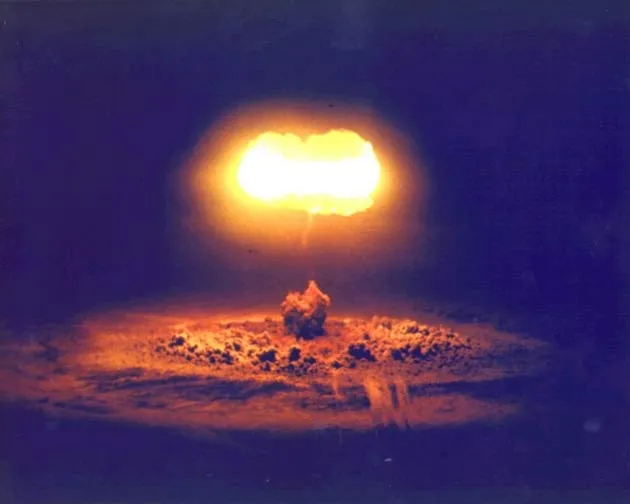
Nuclear bombs are humankind's most powerful weapon, but their destructive impact would unlikely alter the spinning of the Earth on its axis.
One way to see this is to compare the energy of a nuclear blast to that of the rotational motion of the Earth. The largest nuclear bombs have an explosive energy of several tens of megatons, or about 10^17 Joules, whereas the Earth's rotational energy is around 10^29 Joules.
So even if all the force of a nuclear explosion was used to push the Earth in a particular direction, the energy in this push would be less than a trillionth that of the rotational energy.
It would be like trying to divert a speeding car with the energy of a flying mosquito.
Even the largest earthquakes have only a miniscule effect on our planet's spinning. Scientists calculated that the colossal tsunami-causing 2004 Sumatra earthquake caused a slimming of the Earth that shortened the day by a few millionths of a second and shifted the North Pole by an inch.
The amount of fault-moving ("Earth-slimming") energy in this magnitude 9.3 earthquake was estimated at more than 10&^22 Joules, or roughly 100,000 times that of the biggest nuclear bombs. So any effect of a nuclear blast on Earth's rotation would be far below what is measureable.
One final note: Nuclear explosions would have even less influence on the Earth's orbit around the sun, as the planet's orbital energy is 10,000 times greater than its rotational energy. This fact did not prevent the making of the 1961 film "The Day the Earth Caught Fire," in which nuclear testing knocks the Earth out of its orbit and towards the sun.
Get the world’s most fascinating discoveries delivered straight to your inbox.
Follow Life's Little Mysteries on Twitter @llmysteries. We're also on Facebook & Google+.
