














Help NASA Find an Alphabet in the Sky

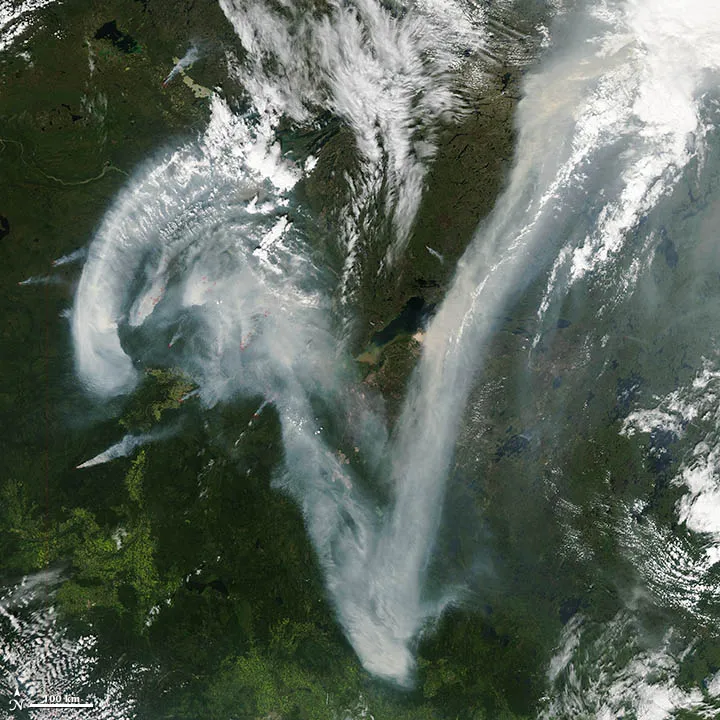
We've all played the game where you peer up at the sky and look for recognizable shapes in the puffy clouds as they roll past and morph with the prevailing winds. Now, there's a chance to scout out cloud shapes from a new perspective: looking down with a satellite's bird's-eye view in NASA's extensive image gallery collection.
Adam Voiland of NASA's Earth Observatory, a website that posts a daily satellite image of our planet, was perusing satellite images when he noticed that an image taken by NASA's Aqua satellite on June 11 featured a smoke plume that looked remarkably like the letter "V."
The smoke plume snaked over northern Canada and was generated by wildfires burning in the Caribou Mountains of northern Alberta.
In a post on the Earth Observatory site, Voiland also noted that if you tilt your head to the right slightly, the smoke plume looks like an "N." (And if you tilt your head to the left, it looks like the number "2," noted Wired.)
Finding this letter made Voiland wonder how many others are out there in satellite images of Earth's atmosphere and oceans that have gone unnoticed, so he's asking for the public's help in searching through the vast satellite images archives to find letters, numbers and other typographic marks.
For links on places to look, see Voiland's Earth Observatory post. If you spot anything, let him know in the comments — it may end up in an Earth Observatory gallery!
Get the world’s most fascinating discoveries delivered straight to your inbox.

Andrea Thompson is an associate editor at Scientific American, where she covers sustainability, energy and the environment. Prior to that, she was a senior writer covering climate science at Climate Central and a reporter and editor at Live Science, where she primarily covered Earth science and the environment. She holds a graduate degree in science health and environmental reporting from New York University, as well as a bachelor of science and and masters of science in atmospheric chemistry from the Georgia Institute of Technology.