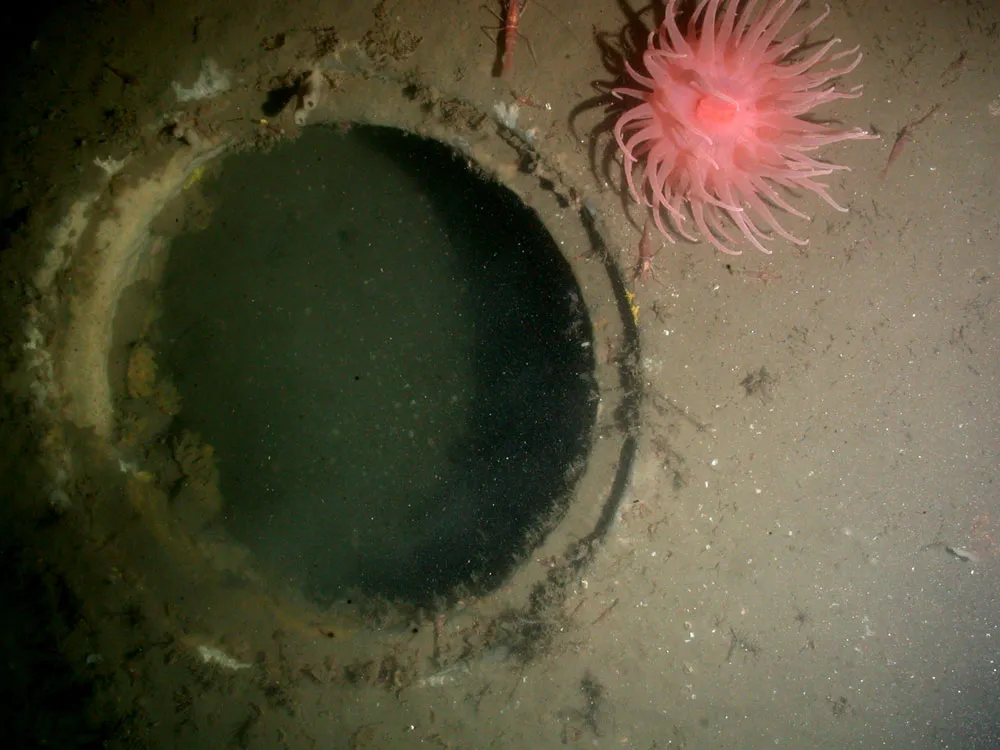
The shipwreck of a 19th century schooner that hauled granite for the construction of burgeoning cities along the U.S. East Coast is getting new protection as a historic relic at Stellwagen Bank National Marine Sanctuary in Massachusetts Bay.
Built in Camden, Maine, the 79-foot, two-masted cargo schooner Lamartine was launched in 1848 and sailed along the Eastern Seaboard for 45 years. While hauling granite sewer heads from Stonington, Maine, to New York City on May 17, 1893, the Lamartine encountered a storm off Cape Ann, Mass. Heavy seas caused the schooner's cargo to shift, capsizing the vessel.
One crew member drowned as the schooner settled beneath the waves, and the captain and mate were tossed into the ocean. Luckily, a fishing schooner returning to Gloucester, Mass., saw the Lamartine sink, and rescued them.
"Lamartine's cargo of cut granite reveals fascinating details about how granite quarried in New England met the demands of a nation growing increasingly urban," said Craig MacDonald, superintendent of the Stellwagen Bank National Marine Sanctuary, run by the National Oceanic and Atmospheric Administration.
The ship is now listed on the National Register of Historic Places, the nation’s official list of cultural resources worthy of preservation, the sixth ship to be listed for Stellwagen, which encompasses 842 square miles of ocean stretching between Cape Ann and Cape Cod offshore of Massachusetts. The sanctuary is famous for its whale watching.
Two and three-masted schooners loaded granite cargos directly from the quarries in Stonington, Maine and Rockport, Mass.
(Image credit: Deborah Marx)
Scientists from NOAA and the University of Connecticut’s Northeast Underwater Research Technology and Education Center (NURTEC) documented the shipwreck with the university’s remotely operated vehicle during several research missions between 2004 and 2006. The fieldwork recorded the vessel's features, including portions of its wooden hull, rigging and granite cargo. This information allowed sanctuary maritime archaeologists, with help from a local maritime historian, to identify the shipwreck and connect it with New England’s cultural landscape that is dotted with granite quarries on coastal headlands and islands.
Sign up for the Live Science daily newsletter now
Get the world’s most fascinating discoveries delivered straight to your inbox.
For the science geek in everyone, Live Science offers a fascinating window into the natural and technological world, delivering comprehensive and compelling news and analysis on everything from dinosaur discoveries, archaeological finds and amazing animals to health, innovation and wearable technology. We aim to empower and inspire our readers with the tools needed to understand the world and appreciate its everyday awe.