














Horseshoe Crab Sex Lures Students to the Beach

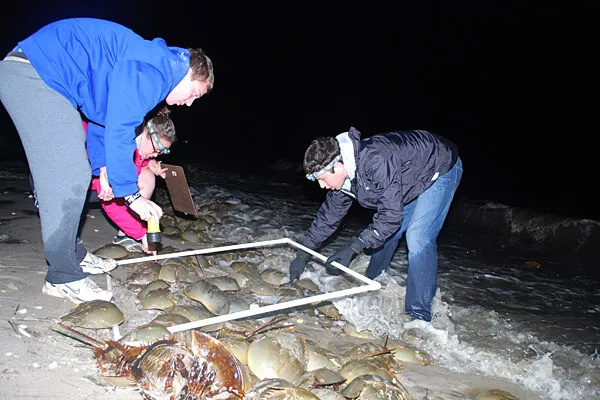
Aspiring marine biologists recently got a taste of the joys (and the occasional discomfort) of real fieldwork during an annual horseshoe crab census in Delaware.
Freshmen in the University of Delaware's first class of marine science majors fanned out across beaches in Delaware Bay in mid-May to count the throngs of horseshoe crabs that come ashore during the month to breed.
Equipped with headlamps and, in many cases, poorly chosen footwear, the students counted the number of male and female horseshoe crabs within a square of PVC-piping placed over the frisky arthropods. The exercise was repeated every 65 feet (20 meters) along the coastline for a distance of 0.6 miles (1 kilometer).
In May and June, when the moon is full or new, horseshoe crabs crowd the region's beaches at high tide. During these months, the amorous crabs gather by the thousands under the cover of darkness.
Males hitch themselves onto the backs of females and get a free ride, as the females crawl along the beach, depositing thousands of small, green eggs — which are fertilized by the accompanying male.
These primeval-looking crabs don't reach sexual maturity until about 10 or 11 years for females, and 8 or 9 years for males, which means that if a population is severely depleted, it takes a long time to replenish its numbers.
The first horseshoe-crab census in Delaware Bay was organized by Delaware Sea Grant in 1990, and now includes multiple organizations.
Get the world’s most fascinating discoveries delivered straight to your inbox.
The would-be scientists who took part in this year's count appeared undaunted by soaked pant legs and shoes, a side effect of the nighttime venture.
"I've never done anything like this before," student Kayla Krenitsky said in a statement. "It's pretty cool."
Follow OurAmazingPlanet for the latest in Earth science and exploration news on Twitter @OAPlanet and on Facebook.
