














Epic Voyage Samples Ocean's Tiniest Sea-Dwellers

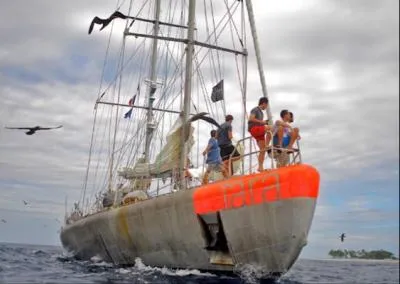
After more than 935 days at sea and a journey of 71,500 miles (115,000 kilometers), an ambitious expedition aimed at sampling the tiniest residents in all of Earth's major oceans has come to an end.
On March 31, the research vessel Tara returned to the port of Lorient, in northern France, the city from which the expedition first departed in September 2009 on a mission to gather microorganisms from the biggest oceans around the world.
"Life and evolution started in the oceans, yet we know very little about the distribution of marine biodiversity," Eric Karsenti, senior scientist at the European Molecular Biology Laboratory in Heidelberg, Germany, said in a statement.
"If it were not for these microorganisms, we would not exist. First, we are their evolutionary descendants, and second, they generate the atmosphere of the Earth," said Karsenti, who is co-director of the project, dubbed Tara Oceans.
Microbes in the ocean comprise 98 percent of the life there, and Tara Oceans scientists are attempting to better understand how these tiny life forms interact with the environment, and how these complex systems have evolved over time.
Different geographical areas and different layers of the ocean host different populations of microorganisms, and the expedition collected samples at various depths from 155 different spots around the globe.
During the two-and-a-half year voyage, different teams took turns on the ship. Tara traveled through the Strait of Gibraltar, across the Mediterranean, through the Suez Canal, and spent time in the Indian Ocean, the Atlantic Ocean, the Southern Ocean near the Antarctic Peninsula and the Pacific Ocean, passing through the Panama Canal and across the Atlantic to return home to France.
Get the world’s most fascinating discoveries delivered straight to your inbox.
By combining genetic data on the microorganisms with real-time satellite maps that reveal various conditions such as temperature and chlorophyll levels in the ocean where the microbes where found, project scientists are hoping to build models that can predict what populations live in different ocean regions, as well as uncover the history of their evolution.
"After the completion of the ocean voyage and the collection phase of the operation, the land-based investigation is truly picking up speed," Karsenti said.
Follow OurAmazingPlanet for the latest in Earth science and exploration news on Twitter @OAPlanet and on Facebook.
