Though some 20,000 people perished or are considered missing after Japan's massive earthquake and tsunami last year, the toll in human lives could have been far worse, one researcher says, noting that a similar event occurring in the U.S. Pacific Northwest could be far more deadly.
The magnitude 9.0 earthquake that struck Japan on March 11, 2011, was the largest known quake to strike the seismically active country and the world's fourth-largest earthquake in recorded history. While the quake itself was responsible for relatively few deaths, the massive tsunami it generated rapidly inundated coastal areas and took some residents by surprise; the raging waters accounted for the bulk of the deaths in the disaster.
Still, some 90 percent the coastal region’s residents and visitors evacuated effectively, said Patrick Corcoran, an Oregon State University education and outreach specialist, who just returned from a disaster symposium at United Nations University in Japan. That figure is a testament to Japan's earthquake planning and drills, he said, as the tsunami had the potential to kill some 200,000 people.
The same situation would likely play out differently in the Pacific Northwest, Corcoran said, because the area isn't as prepared as Japan was. [Pictures: Japan Earthquake & Tsunami]
"Our human nature is not tuned in to long-term threats and 300-year-cycle disasters," Corcoran said in a statement. "It takes a big cultural shift to go from not thinking about an earthquake and tsunami to really and truly expecting one."
The Japanese, Corcoran says, have been well aware of earthquake and tsunami threats for hundreds of years, but the threats to the Pacific Northwest have only been known for a few decades, which plays into the priority preparation is given.
"But we had better start taking the eventuality of an earthquake and tsunami a lot more seriously," Corcoran said.
Sign up for the Live Science daily newsletter now
Get the world’s most fascinating discoveries delivered straight to your inbox.
The Cascadia Fault, which is offshore of the West Coast from Northern California all the way to Canada, has generated a 9.0 magnitude earthquake itself, in 1700. This quake sent a tsunami all the way to Japan.
Inundation line
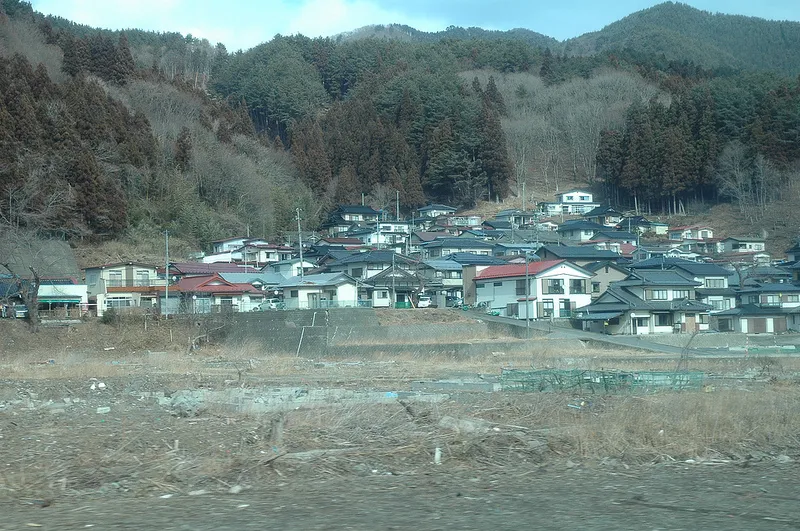
Corcoran has worked for several years with Oregon coastal communities on earthquake and tsunami preparedness, as well as resilience to major storms and other natural hazards. He recently toured several communities in Japan that had been ravaged by the tsunami, most of which had been completely destroyed below the tsunami inundation line.
"What was striking is how intact the homes and schools were just above that elevation," Corcoran said. "There was a clear line of safety. If you got above it, you were safe. If you didn't, you weren't. It wasn't that far for most people — you just had to know where the line was and get to it. And most of them did."
Patrick Corcoran, an Oregon State University education and outreach specialist, tours a devastated town in Japan.
(Image credit: Patrick Corcoran)
Japanese officials are considering this in their rebuilding plans, with suggestions to locate industrial and commercial structures in more vulnerable areas and homes, schools and hospitals beyond the inundation line or on higher ground.
"That is the kind of planning the Pacific Northwest needs to consider," Corcoran said. "It isn't economically feasible to immediately shift our hospitals and nursing homes. But over a period of years or decades, when new facilities are being considered, preference might be given to sites at high elevations."
More planning
Corcoran said state and local agencies in Oregon have begun taking action, including producing new evacuation maps and improving communication and incident command plans, but, he added, individuals need to have a plan as well.
Corcoran's tips: Identify areas of high ground near your home, work and recreation areas. Work to make them accessible. Then conduct practice drills on how to get to them.
"Our society tends to be dismissive of drills," he said," but drills save lives, as they learned in Japan."
For the science geek in everyone, Live Science offers a fascinating window into the natural and technological world, delivering comprehensive and compelling news and analysis on everything from dinosaur discoveries, archaeological finds and amazing animals to health, innovation and wearable technology. We aim to empower and inspire our readers with the tools needed to understand the world and appreciate its everyday awe.