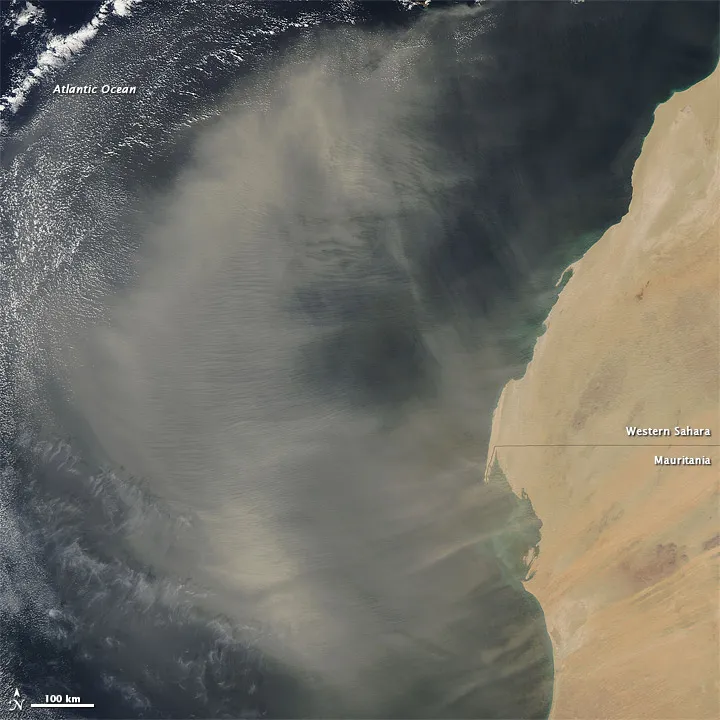
Huge Dust Storm Blows Out to Sea
Get the world’s most fascinating discoveries delivered straight to your inbox.
You are now subscribed
Your newsletter sign-up was successful
Want to add more newsletters?
Delivered Daily
Daily Newsletter
Sign up for the latest discoveries, groundbreaking research and fascinating breakthroughs that impact you and the wider world direct to your inbox.
Once a week
Life's Little Mysteries
Feed your curiosity with an exclusive mystery every week, solved with science and delivered direct to your inbox before it's seen anywhere else.
Once a week
How It Works
Sign up to our free science & technology newsletter for your weekly fix of fascinating articles, quick quizzes, amazing images, and more
Delivered daily
Space.com Newsletter
Breaking space news, the latest updates on rocket launches, skywatching events and more!
Once a month
Watch This Space
Sign up to our monthly entertainment newsletter to keep up with all our coverage of the latest sci-fi and space movies, tv shows, games and books.
Once a week
Night Sky This Week
Discover this week's must-see night sky events, moon phases, and stunning astrophotos. Sign up for our skywatching newsletter and explore the universe with us!
Join the club
Get full access to premium articles, exclusive features and a growing list of member rewards.
From NASA's Earth Observatory:
The dust plumes that arose in the western Sahara Desert on January 18, 2012, continued their westward journey the following day. On January 19, 2012, the Moderate Resolution Imaging Spectroradiometer (MODIS) on NASA’s Aqua satellite captured this natural-color image of a giant, crescent-shaped plume over the Atlantic Ocean.
North to south, the plume spans several hundred kilometers. Off the coast of Western Sahara, the dust forms a faint crosshatch pattern, which implies that dust particles blow in different directions at different altitudes. Most of the dust blows westward. Saharan dust frequently lands on the Canary Islands and Cape Verde, but also sometimes crosses the Atlantic Ocean to the Americas.
Get the world’s most fascinating discoveries delivered straight to your inbox.