













Ancient Sea Spider Related to Scorpion

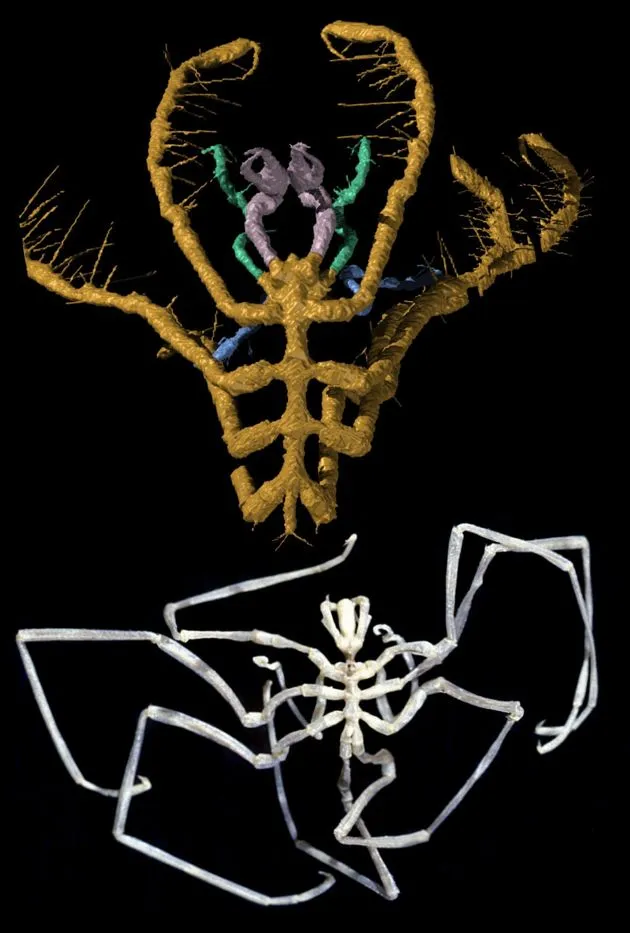
The fossil of an ancient sea spider thought to be related to modern scorpions has been discovered near Herefordshire in the UK.
The 425-million-year-old creature was encased and preserved in volcanic ash.
Sea spiders are soft-bodied arthropods common in oceans today. Biologists have long wondered about the relationship between them and land spiders. They share similar body forms, but a sea spider has a long proboscis and unusual limbs used in mating and carrying embryos.
Sea spiders are delicate, so few of their fossils exist.
"This is the earliest adult fossil example, and it is preserved in extraordinary detail," said Derek Briggs, a professor of geology and geophysics at Yale. "Volcanic ash that trapped ancient sea life in this location rapidly encased the creatures making a concrete-like cast of the bodies. The cavity later filled in with carbonate solids so we have a fossil record to study now."
The specimens were sliced up, with digital images taken with every slice. Then the spider was reconstructed with computer graphics. The reconstruction -- revealing large pincers -- suggests Haliestes dasos, as the species is now named, is indeed related to land spiders, scorpions, mites and ticks.
The discovery was reported in today's issue of the journal Nature.
Get the world’s most fascinating discoveries delivered straight to your inbox.
