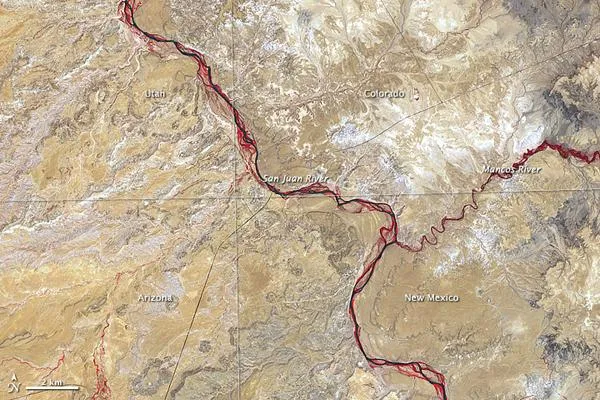
Southwest's Four Corners Seen from Space
Get the world’s most fascinating discoveries delivered straight to your inbox.
You are now subscribed
Your newsletter sign-up was successful
Want to add more newsletters?
Delivered Daily
Daily Newsletter
Sign up for the latest discoveries, groundbreaking research and fascinating breakthroughs that impact you and the wider world direct to your inbox.
Once a week
Life's Little Mysteries
Feed your curiosity with an exclusive mystery every week, solved with science and delivered direct to your inbox before it's seen anywhere else.
Once a week
How It Works
Sign up to our free science & technology newsletter for your weekly fix of fascinating articles, quick quizzes, amazing images, and more
Delivered daily
Space.com Newsletter
Breaking space news, the latest updates on rocket launches, skywatching events and more!
Once a month
Watch This Space
Sign up to our monthly entertainment newsletter to keep up with all our coverage of the latest sci-fi and space movies, tv shows, games and books.
Once a week
Night Sky This Week
Discover this week's must-see night sky events, moon phases, and stunning astrophotos. Sign up for our skywatching newsletter and explore the universe with us!
Join the club
Get full access to premium articles, exclusive features and a growing list of member rewards.
In just one place in the United States do four states meet. The borders of Utah, Colorado, New Mexico, and Arizona intersect at Four Corners, west of the confluence of the Mancos and San Juan Rivers.
Maps from the U.S. Geological Survey (USGS) indicate that most of the rock layers around Four Corners were deposited during the Age of Reptiles, about 248 to 65 million years ago. The rocks formed from fine sediments eroded off older rocks and subsequently deposited by wind and water.
Although water may be in short supply in this region now, it was once abundant. About 70 million years ago, the Four Corners region sat along the western shore of a shallow sea that split North America in two. Marine reptiles such as mosasaurs and mollusks such as ammonites swam in the temperate sea while pterosaurs flew overhead fishing for snacks.
The shallow sea alternately advanced and retreated during the time of the dinosaurs. Around the end of the Mesozoic, today's Rocky Mountains began to rise. Land that was once seafloor is now elevated far above sea level and consists of high desert.
Get the world’s most fascinating discoveries delivered straight to your inbox.