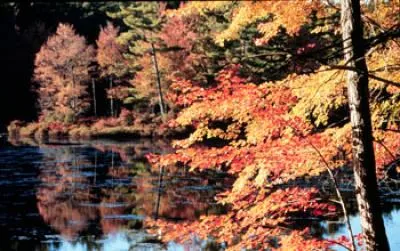
The official start of fall is only weeks away, and with it comes the spectacle of millions of trees turning a riot of amber and scarlet hues. But one of the most iconic of autumn's trees, New England's maple, is being increasingly threatened by a nefarious pest.
The Asian longhorned beetle (Anoplophora glabripennis) is believed to have arrived in New York City and other major cities via shipping containers from China. Its larvae burrow deep into maples and other hardwood tree species and feed on the wood and the vessels within the tree that transport water.
Eradication efforts in Chicago, New York and other cities have focused exclusively on urban street trees, but a new study of an infestation in Worcester, Mass., has shown that the invasive insect can easily spread from tree-lined city streets to neighboring forests.
"From our work it became apparent that [beetle] was readily moving through forests and attacking trees, making it a threat to forests in the region," said study co-leader Kevin Dodds, an entomologist from the U.S. Forest Service.
An infested Worcester maple, showing exit holes from adult Asian longhorned beetles.
(Image credit: Dave Orwig)
Maples under attack
On city streets the insects will attack any tree nearby, but in forests, it almost exclusively targets large maples.
Red maples, the study shows, are particularly vulnerable to infestation. Red maples are widespread in New England and central to the region's fall foliage tourism industry, which attracts more than 1 million visitors annually to New England and generates $1 billion in revenue. Other maple species are key to the region's maple syrup industry. [Related: Why Fall Leaves Change Color]
Sign up for the Live Science daily newsletter now
Get the world’s most fascinating discoveries delivered straight to your inbox.
The beetle was first detected in Worcester in 2008 by a private citizen. At one of the forested study sites in a suburb north of Worcester, nearly two-thirds of all the maples were infested, including red, sugar and Norway maples.
The Worcester outbreak is the largest to date in North America with more than 19,600 infested trees found, more than 1,100,000 trees searched and more than 29,000 trees removed. It is also the largest in quarantined area size. Containment efforts now cover a 98-square-mile area around the city. Forests surrounding Worcester are part of a heavily wooded corridor stretching from New York into New Hampshire, Vermont and Maine.
"If the [beetle] continues to spread outside Worcester, the abundance of red maples could provide a pathway for its dispersal throughout New England and other parts of eastern North America," ecologist David Orwig of Harvard University said.
Tree trunk showing interior damage by Asian longhorned beetles.
(Image credit: Kevin Dodds)
What the future holds
The eradication efforts in the affected tree stands have involved tree harvest and consequently have led to shifts in forest composition from maple to oak, which may have cascading effects on soil processes and ecosystem function.
Orwig notes that a long view is critical to studying and forecasting the impacts of beetle and other invasive pests .
"The duration of the current infestation is unknown, but it is likely to continue for at least several more years," he said. "Only through a long-term approach can we begin to evaluate the impacts of how ecosystems are impacted over decades and longer."
The results of the study appeared Aug. 30 in the Canadian Journal of Forest Research.
For the science geek in everyone, Live Science offers a fascinating window into the natural and technological world, delivering comprehensive and compelling news and analysis on everything from dinosaur discoveries, archaeological finds and amazing animals to health, innovation and wearable technology. We aim to empower and inspire our readers with the tools needed to understand the world and appreciate its everyday awe.