














The Jewel-Toned Lakes of the Qinghai-Tibet Plateau

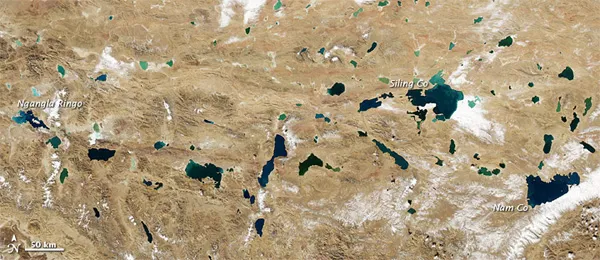
The Qinghai-Tibet Plateau gives rise to most of Asia's major rivers, and holds a constellation of salt- and freshwater lakes.
NASA's Aqua satellite captured this natural-color image of the Tibetan Plateau on Nov. 10. Due to differences in depth, sediments and microscopic organisms in the various lakes, they collectively present a myriad of greens, blues and teals when viewed from above.
The lakes in this region typically lack outlets, allowing the accumulation of minerals that, combined with other features, influence lake color. The lakes vary widely in surface area and shape. Two of the largest in this scene are Siling Co and Nam Co.
Nam Co is one of the worldâ??s highest-altitude salt lakes , with a lake surface at 15,480 feet (4,718 meters); the lake measures roughly 49 by 16 miles (79 by 25 kilometers). Inflow rivers bring water into the lake from glaciers , and studies have found that the water level has risen between 1976 and 2001, and in 2005 and 2006.
Siling Co, the other largest lake, has a shape and color that vary more than Nam Co's. The lake's blue-green hue ranges from light to dark. Surrounding Siling Co are smaller water bodies that used to be part of a larger lake. Today, Siling Co can be found at an altitude of 14,860 feet (4, 530 m) and measures about 48 by 13 miles (78 by 21 km). Unlike Nam Co, this lake is replenished mostly by surface runoff.
While Siling Co and Nam Co have both been gaining water over the years, a study published in 2008 found that most lakes of the Qinghai-Tibet Plateau are actually losing water.
- In Images: Hiking the Himalayas
- Infographic: Tallest Mountain to Deepest Ocean Trench
- How Did the Tibetan Plateau Form?
Get the world’s most fascinating discoveries delivered straight to your inbox.
