














Dust Blows Over Egypt, Libya and the Mediterranean Sea

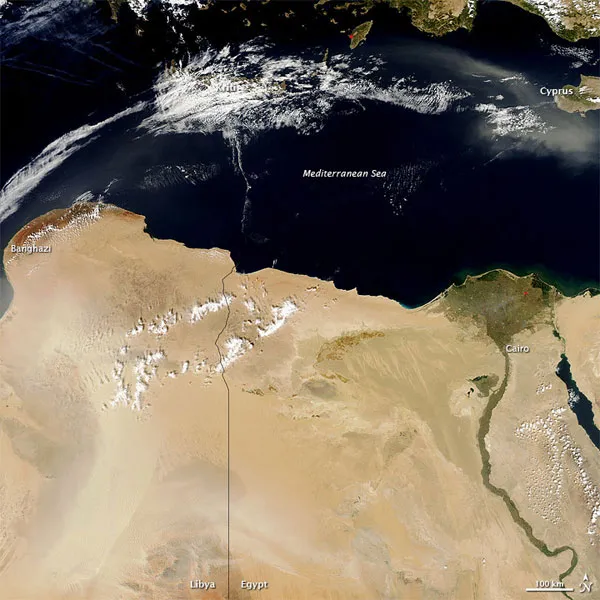
A few days after dust plumes blew off the coast of Libya, another dust storm spreads over Egypt, Libya and the Mediterranean Sea.
NASA's Aqua satellite captured this natural-color image of the dust storm on Oct. 1, 2010. The dust is thickest over central Libya, and thinner, but still discernible dust, appears over Egypt. Over the Mediterranean Sea, dust and clouds form an arc that extends eastward toward Cyprus.
The Mediterranean often has dust blown over it because strong winds over the Sahara push the dust out over the water.
The points of origin of the dust storms are not obvious; the dust most likely arose from the massive sand seas that sprawl over Libya and Egypt.
The Nile River is present in this image as well, as a green band twisting through the desert. The Nile is the longest river in the world, extending for about 4,163 miles (6,700 kilometers) from its headwaters in the highlands of eastern Africa to its mouth at the Mediterranean.
The green bordering the river is its fertile floodplain, which is fed by flood waters from the river. There is a sharp contrast between the floodplain and the arid landscape farther away from the river, which is largely due to elevation changes. The floodplain rests inside the floor of a large meandering valley, surrounded by valley walls that lead up to the desert highlands.
- The World's Longest Rivers
- The Harshest Environments on Earth
- The World's Weirdest Weather
Get the world’s most fascinating discoveries delivered straight to your inbox.
