













Margin Notes Shed New Light on Renaissance Anatomy Masterpiece

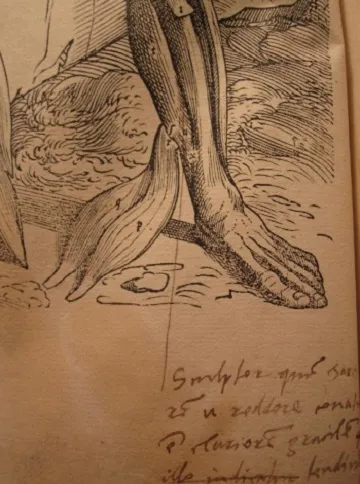
When the Renaissance physician and expert dissector Andreas Vesalius first published "De humani corporis fabrica" in 1543, he provided the most detailed look inside the human body of his time.
A previously unknown copy of the impressive anatomy textbook resurfaced a few years ago, and it apparently contains more than a thousand handwritten notes and corrections by the author himself. The annotations reveal that Vesalius was meticulously planning a third edition of the book that never made it to print, researchers say.
"This book is his workbench as much as the dissecting table," Vivian Nutton, a University College London professor emeritus, writes in a recently published analysis of the text in the journal Medical History.
Some edits show that Vesalius wanted to correct mistakes of grammar and syntax and to make his Latin more elegant. Other markings show that he wanted to draw attention to misshapen or illegible letters for his block-cutter. Vesalius also intended to add new information to the text as he learned more about the human body, including what may be one of the oldest references to the practice of female genital mutilation.
In his discussion of circumcision, Vesalius scrawled at the bottom of the page that Ethiopians "cut off the fleshy processes from new born girls in accordance with their religion in the same way as they remove the foreskins of boys, 'although in their religious ceremonies they are otherwise generally similar to those of us Christians,'" Nutton writes. "This is arguably the first reference in a medical text to female genital mutilation for non-medical purposes." [5 Things You Didn't Know About Circumcision]
The copy of the book, on loan from an unnamed German collector, is currently available for study at the University of Toronto's Thomas Fisher Rare Book Library.
"He is seen constantly attempting to improve his text both scientifically, and stylistically, and to make it clearer and more accessible to his readers," Philip Oldfield, science and medicine librarian at the University of Toronto, said in a statement. "All the evidence points to the conclusion that Vesalius was preparing a new edition of De fabrica that unfortunately never materialized."
Get the world’s most fascinating discoveries delivered straight to your inbox.
The book will be featured as part of an exhibition next year in Toronto to mark the 500th anniversary of Vesalius' birth.
Follow Megan Gannon on Twitter and Google+. Follow us @livescience, Facebook & Google+. Original article on LiveScience.com.
