













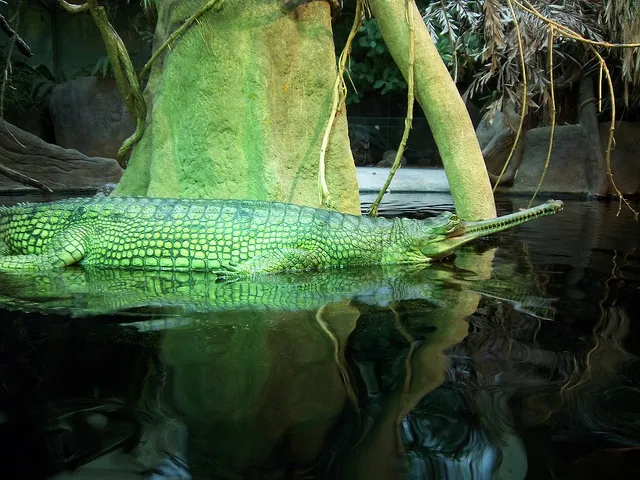
A massive extinction between the Triassic and Jurassic eras paved the way for the rise of the crocodiles, new research suggests.
The researchers, who detail their work today (March 26) in the journal Biology Letters, found that although nearly all the crocodilelike archosaurs, known as pseudosuchia, died off about 201 million years ago, the one lineage that survived soon diversified to occupy land and sea. The lineage included the ancestors of all modern crocodiles and alligators.
"Even though almost all the lineages except for one was extinct, the remaining survivors still did well in terms of morphology and body plans and the whole morphological diversity," said study co-author Olja Toljagić, an evolutionary biology researcher who was at the Ludwig Maximilian University of Munich at the time of the study.
Understanding the traits that allowed certain lineages to thrive could one day help paleontologists untangle one of the greatest mysteries: how dinosaurs survived the extinction unscathed and took over Earth. [Mysterious Earth: 50 Amazing Facts]
Dinosaur counterparts
During the Triassic period, two lines of archosaurs lived in the same environment, which included dinosaurs, and the pseudosuchians, a large group of crocodilelike creatures that had short necks, long snouts and massive skulls.
But around 201 million years ago, volcanic activity or a meteor killed off half the known species on Earth. Just one lineage of pseudosuchians, called the crocodylomorphs, survived. That branch would ultimately give rise to modern-day crocodiles and alligators.
Get the world’s most fascinating discoveries delivered straight to your inbox.
Crocodile line
In order to find out what happened to the pseudosuchians during the mass extinction, Toljagić and her colleague Richard Butler analyzed previous research data on pseudosuchians' skull characteristics, which could provide details about species diversity.
After doing a systematic analysis, the team found that the single surviving branch not only survived the extinction, but showed great diversity within a few million years after the extinction. These diversified crocodilelike creatures fanned out into different environments ― such as swamps, rivers and oceans ― during the Triassic period.
Ecological opportunity
The findings suggest that the extinction allowed crocodiles to flourish, said Stephen Brusatte, a paleontologist at the University of Edinburgh, who was not involved in the study.
"That extinction seems to have had a major effect by knocking off many species and then giving new species a chance," Brusatte told LiveScience.
The next step is to try to piece together a similarly detailed picture for dinosaurs around the same time in order to understand how dinosaurs survived the extinction, he said.
Follow Tia Ghose on Twitter @tiaghose. Follow LiveScience @livescience, Facebook & Google+. Original article on LiveScience.com.

Tia is the editor-in-chief (premium) and was formerly managing editor and senior writer for Live Science. Her work has appeared in Scientific American, Wired.com, Science News and other outlets. She holds a master's degree in bioengineering from the University of Washington, a graduate certificate in science writing from UC Santa Cruz and a bachelor's degree in mechanical engineering from the University of Texas at Austin. Tia was part of a team at the Milwaukee Journal Sentinel that published the Empty Cradles series on preterm births, which won multiple awards, including the 2012 Casey Medal for Meritorious Journalism.