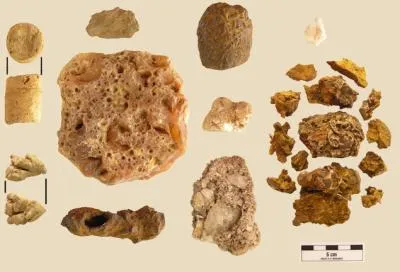
Archaeologists have unearthed nearly 5,000-year-old shaman's stones in a rock shelter in Panama. The stone collection may be the earliest evidence of shamanic rituals in that region of Central America, researchers say.
The 12 stones were found in the Casita de Piedra rock shelter, in the Isthmus of Panama. The rocks, which carbon-dating of surrounding material showed to be between 4,000 and 4,800 years old, were clustered in a tight pile. That suggests they had been carried there, likely in a leather pouch that has long-since disintegrated, said study co-author, Ruth Dickau, an archaeologist at the University of Exeter, in an email.
"If our interpretation is correct, it constitutes the earliest material evidence in lower Central America of shamanistic practice," the authors wrote in the article.
The findings were published online Dec. 27 in the journal Archaeological and Anthropological Sciences.
The Pre-Columbian rock shelter was first discovered in the 1970s, and was initially thought to have been used by people since about 6,500 years ago. In 2006 Dickau reanalyzed the shelter and found that people had used the shady nook for cooking and tool-making for over 9,000 years. During the excavations, she also uncovered the mysterious cache of stones. [In Photos: Amazing Ruins of the Ancient World]
The stones were found in a rock-shelter in Panama that has been used by humans for more than 9,000 years
(Image credit: Eduardo Berejano)
The collection, which included translucent quartz, pyrite, magnetic rocks and bladed tools, was likely used in shamanic rituals because of how closely together they were packed, Dickau told LiveScience. Some of the rocks contained grains of iron called magnetite, and showed magnetic properties by deflecting a compass needle. In addition, the stone types themselves don't come from the rock shelter, but were historically used in shamanic rituals throughout the region.
The stones came from a distant, gold-rich region of Panama called the Central Cordillera up to 3,000 years before mining of the precious metal began, said study co-author and consulting geologist Stewart Redwood in a statement.
Sign up for the Live Science daily newsletter now
Get the world’s most fascinating discoveries delivered straight to your inbox.
"However, there are no gold artifacts in the rock shelter, and there's no evidence that the stones were collected in the course of gold prospecting as the age of the cache pre-dates the earliest known gold artifacts from Panama by more than 2,000 years," Redwood said in a statement.
The shaman who once used these rocks probably belonged to an indigenous culture that lived off maize, manioc and wild tubers. But the story of the rocks themselves may remain an enigma.
"We will never be entirely sure how the ancient people used the stones in the past," Dickau wrote.
Modern-day practices, however, can provide some clues. Even today, indigenous shamans in Costa Rica will chant, sing and blow tobacco smoke over stones to communicate with otherworldly spirits or diagnose illnesses, she wrote. The stones' movement in the shaman's hands are taken as responses to questions. In addition, in indigenous myths and stories in the region, crystals are linked to transformative experiences.
Tia is the editor-in-chief (premium) and was formerly managing editor and senior writer for Live Science. Her work has appeared in Scientific American, Wired.com, Science News and other outlets. She holds a master's degree in bioengineering from the University of Washington, a graduate certificate in science writing from UC Santa Cruz and a bachelor's degree in mechanical engineering from the University of Texas at Austin. Tia was part of a team at the Milwaukee Journal Sentinel that published the Empty Cradles series on preterm births, which won multiple awards, including the 2012 Casey Medal for Meritorious Journalism.