














Building Green-Gas Technology Without a Manual
This ScienceLives article was provided to LiveScience in partnership with the National Science Foundation.
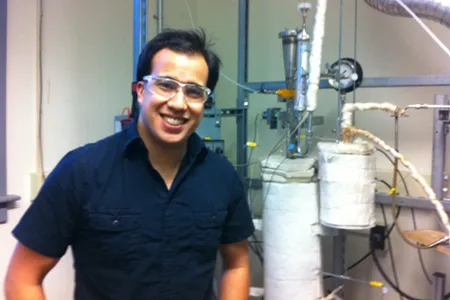
As a graduate researcher at the University of Massachusetts Amherst, I design and build biofuel reactors and study how the chemicals that make up plants interact with catalysts to form fuel. I use a combination of experiments and mathematical models to gain a deeper understanding of the chemistry involved.
Under the direction of George Huber and Lakis Mountziaris, I study a technique for producing biofuels known as catalytic fast pyrolysis. Rather than using microbes, CFP is a one-step, thermo-catalytic technique for converting inedible plant matter (such as sawdust, corn stover and switchgrass) into fuels that work in today’s automobiles. As industry integrates this and related technologies on a progressively larger scale, you’ll hopefully start seeing green gasoline at your local pump. Unless there’s a sign that tells you your gas came from wood or grass, you won’t be able to tell the difference.
For more information, see Green Gasoline Comes Closer to Fueling Your Car.
Name: Robert Coolman Age: 26 Institution: University of Massachusetts, Amherst Field of Study: Chemical Engineering, Biofuels
Editor's Note: The researchers depicted in ScienceLives articles have been supported by the National Science Foundation, the federal agency charged with funding basic research and education across all fields of science and engineering. Any opinions, findings, and conclusions or recommendations expressed in this material are those of the author and do not necessarily reflect the views of the National Science Foundation. See the ScienceLives archive.
Get the world’s most fascinating discoveries delivered straight to your inbox.
Robert Coolman, PhD, is a teacher and a freelance science writer and is based in Madison, Wisconsin. He has written for Vice, Discover, Nautilus, Live Science and The Daily Beast. Robert spent his doctorate turning sawdust into gasoline-range fuels and chemicals for materials, medicine, electronics and agriculture. He is made of chemicals.