













Traffic Makes Grasshoppers Sing Higher, Louder

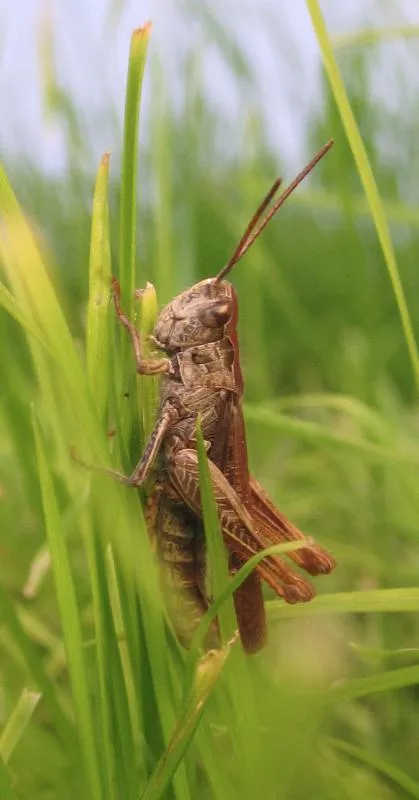
City-dwelling male grasshoppers sing louder and at a higher pitch than their country kin so that their females can hear them over the din of traffic, suggests the first study to examine the effect of urban noise on insect song.
Ulrike Lampe and her colleagues from Bielefeld University in Germany caught 188 male bow-winged grasshoppers in the northwest of the country, half from the sleepy countryside and the other half from bustling roadsides. Then they made nearly 1,000 recordings of the hoppers' tunes and compared the different groups.
"We are able to demonstrate that man-made noise (in this case traffic noise) does not only affect acoustic communication in vertebrates, but also in insects," Lampe wrote in an email. "We also show that the changes in signal production in these grasshoppers are long-term changes, since we recorded all of them under quiet conditions 24 to 72 hours after we caught them." [Listen to City Grasshoppers Sing]
Males from roadside habitats shifted their tunes to higher frequencies, at least in the lower register of their songs.
"This part of the spectrum overlaps with traffic noise, and could thus be masked or degraded by noise," Lampe wrote. "Even if males from roadside habitats use signals with only a slightly upwards-shifted peak, this could increase the probability that this part of the signal is heard by females."
The fact that the bow-winged grasshopper is one of the most abundant grasshopper species in central Europe suggests it is not affected too badly by noise, Lampe said.
Lampe's research also has shown that grasshoppers living next to older roads, where the noise of traffic has been around longer, tend to be able to reach higher notes, she said.
Get the world’s most fascinating discoveries delivered straight to your inbox.
The bow-winged grasshopper is about 0.6 inches (1.5 centimeters) long and varies in color from green to brown to red. The male's song consists of a pair of one-second-long phrases. It produces its music by rubbing a tooth file on its hind legs against a protruding vein on its front wings.
Reach Douglas Main at [email protected]. Follow him on Twitter @Douglas_Main. Follow LiveScience on Twitter @livescience. We're also on Facebook& Google+.
