Beeswax Filling May Be Oldest Hint of Dentistry

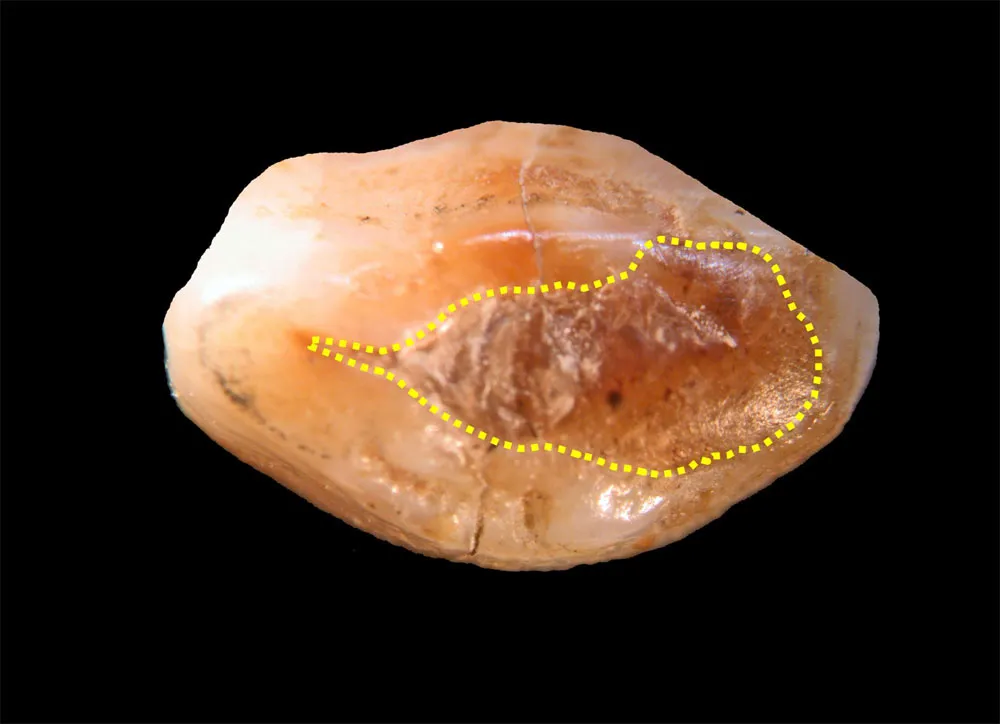
An ancient cracked tooth repaired with a filling made of beeswax may be the earliest known example of therapeutic dentistry, researchers say.
The tooth is 65 centuries old and was part of a man's jaw found more than 100 years ago in Slovenia.
Definite evidence of ancient dentistry is rare. The oldest examples are 7,500- to 9,500-year-old molars found in Pakistan that had regularly shaped cavities with concentric ridges drilled into them. Other, more questionable finds include a 5,500-year-old artificial tooth from Egypt.
Scientists reported online today (Sept. 19) in the journal PLoS ONE that they found the filling as they analyzed a 6,500-year-old lower jaw recovered from a cave near Trieste, Italy. The jaw, which once belonged to a 24- to 30-year-old man, included a left canine tooth possessing a vertical crack in its hard enamel and softer dentin layers. The severe wear and tear seen on the tooth was probably due to activities besides eating, the researchers said — for instance, men of the time might have used their teeth to soften leather or help make tools, and the women bit down on threads to hold them while weaving.
The researchers found beeswax had been applied to the left canine at about the time of the man's death.
"It was extremely difficult for somebody to identify the dentistry work by naked eye or simple tools," researcher Claudio Tuniz, a nuclear paleoanthropologist at the Abdus Salam International Center for Theoretical Physics in Italy, told LiveScience. The lower jaw had remained at the international center "for 101 years without somebody noticing anything strange on the canine," Tuniz said.
The researchers managed to figure out the age of the beeswax using a large ion accelerator, which let them see what carbon isotopes were in the wax. All isotopes of carbon have six protons but differ in the number of neutrons they possess. The carbon-14 isotope is unstable and decays over time, so analyzing the ratio of carbon-14 to other carbon isotopes can shed light on how much time has passed. The researchers also used X-rays from another powerful particle accelerator to get a 3D picture of the tooth with a resolution of about one-thousandth of a millimeter.
Get the world’s most fascinating discoveries delivered straight to your inbox.
They could not confirm whether this filling was made shortly before or after the person's death. If it was when the person was still alive, "this finding is perhaps the most ancient evidence of prehistoric dentistry in Europe," said researcher Federico Bernardini, an archaeologist at the international center, in a statement. It may be the oldest known direct example of a therapeutic dental filling uncovered to date, Bernardini added.
Assuming this filling was a case of dentistry, it was likely meant to reduce pain and sensitivity. The researchers would like to conduct dental experiments with people to see how effective a remedy beeswax is.
"At the moment we do not have any idea if this is an isolated case or if similar interventions were quite spread in Neolithic Europe," Bernardini told LiveScience. "In collaboration with our interdisciplinary team, we are planning to analyze other Neolithic teeth in order to understand how widespread these types of interventions were."