














Pew! Pew! Pew! NASA's Curiosity Rover Zaps Mars Rock with Laser

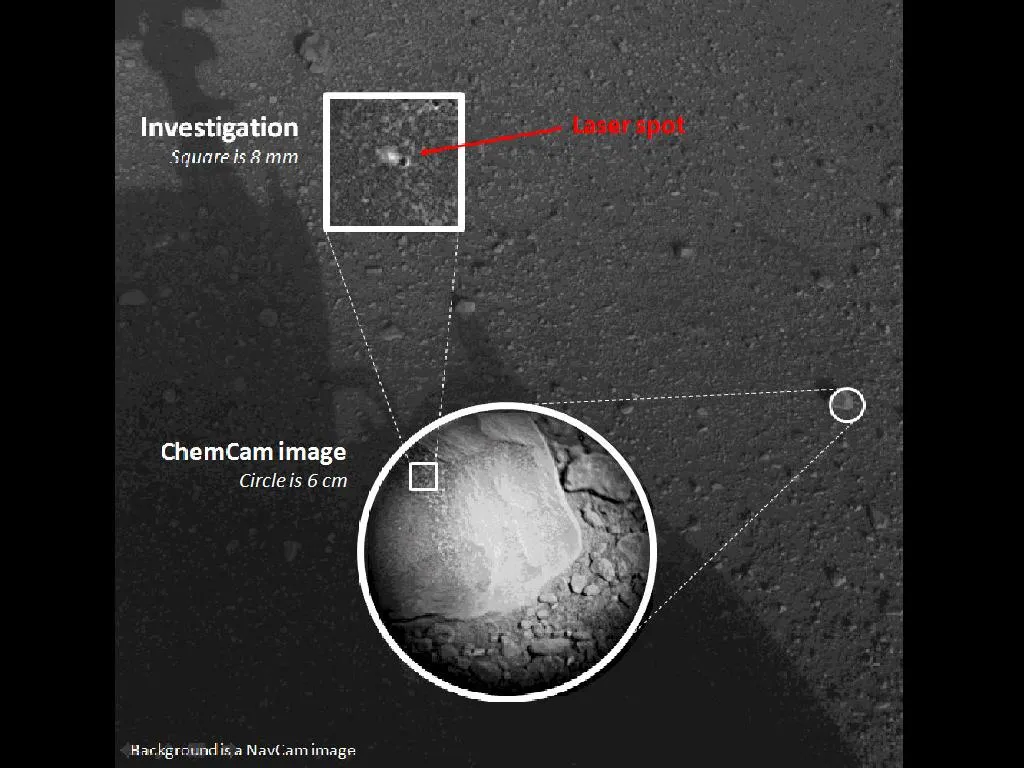
A NASA rover has fired the first laser gun on Mars to take a peek inside a small Martian rock.
The Mars rover Curiosity zapped a rock scientists are now calling "Coronation" on Sunday (Aug. 19) to test an instrument that measures the composition of targets hit by its powerful laser beam. The rover fired 30 laser pulses in 10 seconds at the fist-size Coronation rock in order to analyze the results.
"We got a great spectrum of Coronation — lots of signal," said Roger Wiens, lead scientist for the rover's laser-wielding instrument at the Los Almos National Laboratory in New Mexico, in a statement. "Our team is both thrilled and working hard, looking at the results. After eight years building the instrument, it's payoff time!"
Curiosity's Chemical and Camera instrument, or ChemCam, fires a laser pulses that last just five one-billionths of a second but deliver more than a million watts of power, enough to turn solid rock into an ionized plasma. A trio of spectrometers in the tool then studies the sparks from the laser fire on 6,144 different wavelengths of ultraviolet, visible and infrared light to determine the composition of the vaporized rock.
Sunday's laser firing was primarily target practice for Curiosity, but early results suggest the high-tech instrument is working well, mission managers said. Data from the test showed ChemCam is performing even better than in ground tests on Earth, they added.
"It's so rich, we can expect great science from investigating what might be thousands of targets with ChemCam in the next two years," said instrument deputy project scientist Sylvestre Maurice of the Institut de Recherche en Astrophysique et Planétologie (IRAP) in Toulouse, France.
ChemCam is one of 10 instruments packed on Curiosity that rely on the rover's plutonium power source to study Mars. The $2.5 billion rover landed on the Red Planet on Aug. 5 and is expected to explore its Gale Crater landing site for the next two years to determine if the region could have ever supported microbial life.
Get the world’s most fascinating discoveries delivered straight to your inbox.
This story was provided by SPACE.com, a sister site to LiveScience. You can SPACE.com on Twitter @Spacedotcom. We're also on Facebook & Google+.
