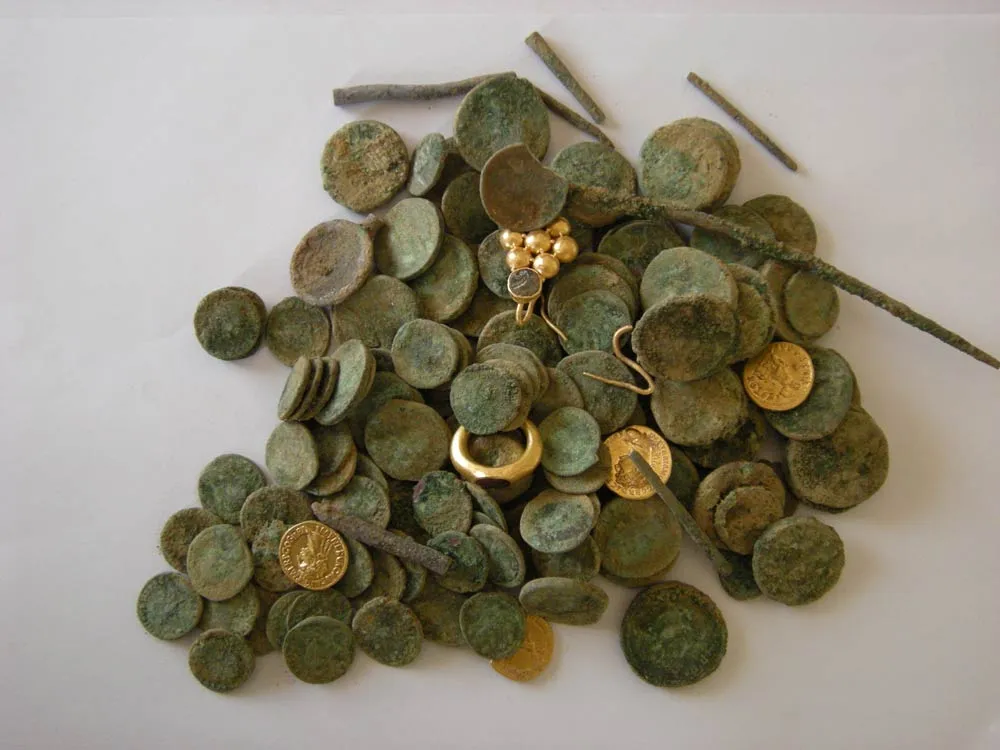
Archaeologists uncovered about 140 gold and silver coins along with gold jewelry in a pit in the courtyard of an exposed building dating to the Roman and Byzantine period.
(Image credit: Sharon Gal, courtesy of the Israel Antiquities Authority.)
A trove of gold and silver coins and jewelry discovered near the Qiryat Gat in Israel was likely stashed there by a wealthy woman during the Bar Kokhba Revolt, the last Jewish-Roman war, archaeologists announced today (June 5).
Scientists uncovered about 140 gold and silver coins, along with gold jewelry, during an excavation that exposed rooms of a building dating to the Roman and Byzantine period. The treasure trove was wrapped in cloth and hidden in a pit in the building's courtyard.
The jewelry could make even a modern gal smile; among the hoard is a flower-shaped earring and a ring holding a precious stone that is covered with a seal of a winged goddess. Two sticks of silver in the trove were likely kohl sticks, which were used type of like eyeliner in Arabia and Egypt to darken the edges of eyelids. The coins date to the reigns of emperors Nero, Nerva and Trajan, who ruled the Roman Empire from about A.D. 54 to 117; the emperors' images adorn one side of the coins.
Among the treasure is a ring holding a precious stone that is covered with a seal of a winged goddess.
(Image credit: Clara Amit, courtesy of the Israel Antiquities Authority.)
And the other side of the coins shows cultic portrayals of the emperors, symbols of the brotherhood of warriors and mythological gods such as Jupiter seated on a throne or Jupiter grasping a lightning bolt in his hand. [See Photos of the Treasure Trove]
"The composition of the numismatic artifacts and their quality are consistent with treasure troves that were previously attributed to the time of the Bar Kokhba Revolt," said archaeologist Sa'ar Ganor of the Israel Antiquities Authority.
Ganor added that during the uprising, between 132 and 135, the Jews under Roman rule would re-stamp coins showing the emperor Trajan with symbols of the revolt.
"This is probably an emergency cache that was concealed at the time of impending danger by a wealthy woman who wrapped her jewelry and money in a cloth and hid them deep in the ground prior to or during the Bar Kokhba Revolt," Ganor said in a statement. "It is now clear that the owner of the hoard never returned to claim it."
Sign up for the Live Science daily newsletter now
Get the world’s most fascinating discoveries delivered straight to your inbox.
The treasure trove is now in the laboratories of the Artifacts Treatment Department of the Israel Antiquities Authority in Jerusalem.
The excavation, which was undertaken on behalf of the Israel Antiquities Authority, was funded by Y.S. Gat Ltd., the Economic Development Corporation for the Management of the Qiryat Gat Industrial Park.
Follow LiveScience for the latest in science news and discoveries on Twitter @livescience and on Facebook.
Jeanna Bryner is managing editor of Scientific American. Previously she was editor in chief of Live Science and, prior to that, an editor at Scholastic's Science World magazine. Bryner has an English degree from Salisbury University, a master's degree in biogeochemistry and environmental sciences from the University of Maryland and a graduate science journalism degree from New York University. She has worked as a biologist in Florida, where she monitored wetlands and did field surveys for endangered species, including the gorgeous Florida Scrub Jay. She also received an ocean sciences journalism fellowship from the Woods Hole Oceanographic Institution. She is a firm believer that science is for everyone and that just about everything can be viewed through the lens of science.