

















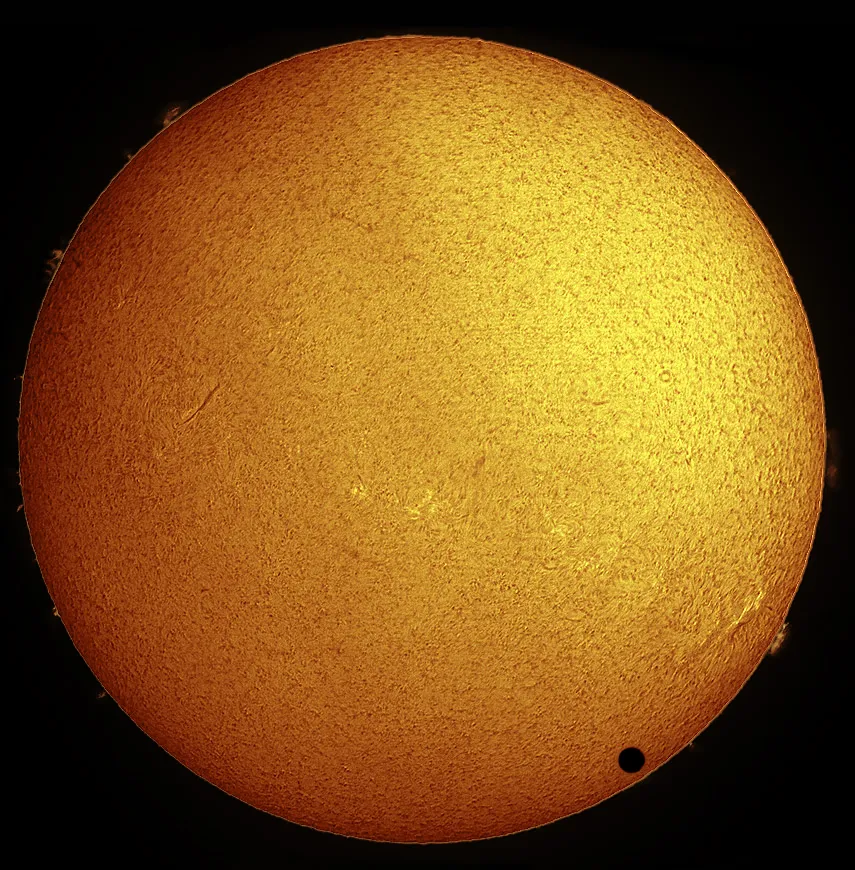
Many people are planning to watch the transit of Venus on Tuesday (June 5), but it's extremely important that prospective viewers be warned to take special precautions (as with a solar eclipse) to view the silhouette of Venus against the brilliant disk of the sun.
For the United States and Canada the transit will begin when the dark disk of Venus first touches the outer edge of the sun, an event that astronomers call Contact I. From the Eastern U.S. and Eastern Canada, Contact I should occur around 6:03 p.m. EDT (2203 GMT). From the Western U.S. and Western Canada, Contact I should occur around 3:06 p.m. PDT.
It will take about 18 minutes for the black disk of Venus to move completely onto the sun's face; ultimately bringing its black disk just inside the sun's upper left edge. If you imagine the sun's disk as the face of a clock, Contact I will occur between the 11:30 and 12 o'clock position. Venus will then progress along a track that will run diagonally from the upper left to the lower right.
If you wish to generate predictions for the transit times from where you live, the Astronomical Applications Department of the US Naval Observatory has produced an online Transit Computer at: http://www.usno.navy.mil/USNO/astronomical-applications/data-services/transit-us
Unlike transits of the sun involving the planet Mercury, those of Venus are readily visible with the unaided eye; the planet appears as a distinct — albeit tiny — black spot with a diameter just 1/32 that of the sun. This size is large enough to readily perceive with the naked eye. [Venus Transit of 2004: 51 Amazing Photos]

But Again . . . Be Careful!
Eye safety is always a prime concern when dealing with the sun. Observing a transit is a lot like studying sunspots because, after all, you are looking at a dark spot on the sun.
Get the world’s most fascinating discoveries delivered straight to your inbox.
But trying to see a transit is also like trying to view a solar eclipse. You have to be ready at a particular time, and you may have to travel far from home. For the transit of Venus, however, your exact location is much less critical than it is for a total solar eclipse.
In particular, observers in Eastern North America, where the transit will happen in the early evening, your observing site should have a low horizon to the east-northeast. It is a good precaution to check the sun's setting point, to verify that trees or buildings do not block your view. As Venus moves across the face of the sun, it will appear absolutely jet black in contrast to the lighter gray of any sunspots that may also be present on the solar disk.
By far, the safest way to view the transit is to construct a so-called pinhole camera. A pinhole, or small opening, is used to form an image of the sun on a screen that is placed about three feet behind the opening. [Video: How to Make a Solar Eclipse Viewer]
Binoculars or a small telescope mounted on a tripod can also be used to project a magnified image of the sun onto a white card. Just be sure not to look through the binoculars or telescope when they are pointed directly at the sun! Venus should appear as a distinct, albeit tiny dot on the projected image.
A variation of the pinhole theme is the "pinhole mirror." To make one, cover a pocket mirror with a piece of paper that has a quarter-inch hole punched in it. Open a sun-facing window and place the covered mirror on the sunlit sill so that it reflects a disk of light onto the far wall inside.
The disk of light is an image of the sun's face. The farther away from the wall you place it the better; the image will be only one inch across for every 9 feet (2.7 meters) from the mirror. Modeling clay works well to hold the mirror in place.
Experiment with different-size holes in the paper. Again, a large hole makes the image bright, but fuzzy, and a small one makes it dim but sharp. Darken the room as much as possible for the best effect. Be sure to try this out beforehand to make sure the mirror's optical quality is good enough to project a clean, round image. Of course, don't let anyone look at the sun in the mirror.
Acceptable filters for unaided visual solar observations include aluminized Mylar. Some astronomy dealers carry Mylar filter material specially designed for solar observing. Also acceptable is shade 13 or 14 arc-welder's glass, which is available for just a few of dollars at welding supply shops.
Unacceptable filters include sunglasses, old color film negatives, photographic neutral-density filters, and polarizing filters. Although these materials have very low visible-light transmittance levels, they transmit an unacceptably high level of near-infrared radiation that can cause a thermal retinal burn. The fact that the sun appears dim, or that you feel no discomfort when looking at the sun through the filter, is no guarantee that your eyes are safe.

Using a Telescope
Projecting the sun’s magnified image through binoculars, or better yet a telescope, on to a white card or screen is relatively safe and can be used for group viewing. For serious transit observing, a telescope with a full-aperture solar filter is much better. These filters are attached to the side of the telescope that faces the sun, not the side facing your eye. This will cause most of the sunlight to be filtered out before entering your telescope. [How to Safely Photograph the Venus Transit (Photo Guide)]
The transit should be watched only with an appropriate solar filter — a solar filter that is sold by a reputable outlet of astronomical equipment. If your telescope comes with a filter that screws into the eyepiece, discard it immediately! These filters have been known to crack under the intense heat of the sun's magnified image.
Lastly, never look at the sun directly through your telescope, even through your finder scope. It is strongly advisable to cover the finder before the transit, so as to avoid looking through it accidentally.
Somebody recently asked me if they could look at the sun through their telescope while wearing a pair of "eclipse glasses" – special filters mounted on cardboard eyeglass frames. The answer is absolutely not! Such a filter is for naked-eye use only! If you try looking through the eyepiece of binoculars or a telescope while wearing these glasses, the concentrated heat from the sun will almost certainly melt a hole through the filtering material, allowing a sudden burst of dazzling sunlight to reach your eye.

Next Time?
Should poor weather hinder or completely obscure your view of the Venus transit, the next opportunity will not come until Dec. 10, 2117. Unfortunately, most who are now reading these words are not likely to be around when that date finally comes around. [Last Venus Transit In Your Lifetime (Video Show)]
Furthermore, much of North America will miss out on the 2117 event, as the transit will not begin until the sun has set. Only observers in the far west will be able to see the very beginning of Venus’s march across the sun before sunset.
The Venus transit of Dec. 8, 2125, however, will be kinder to North America. Venus will begin its passage across the sun soon after sunrise for the East Coast. For the rest of the continent, Venus will already be on the sun as it rises. The final two or three hours of the transit will be visible from the west coasts of Canada and the U.S.
Editor's note: If you snap a great photo of the Venus transit and would like to share it with SPACE.com for a story or gallery, please send images and comments to SPACE.com managing editor Tariq Malik at [email protected].
This story was provided by SPACE.com, a sister site to LiveScience. Joe Rao serves as an instructor and guest lecturer at New York's Hayden Planetarium. He writes about astronomy for The New York Times and other publications, and he is also an on-camera meteorologist for News 12 Westchester, New York.
