













Video Game Tech Helps Coordinate Satellite Docking

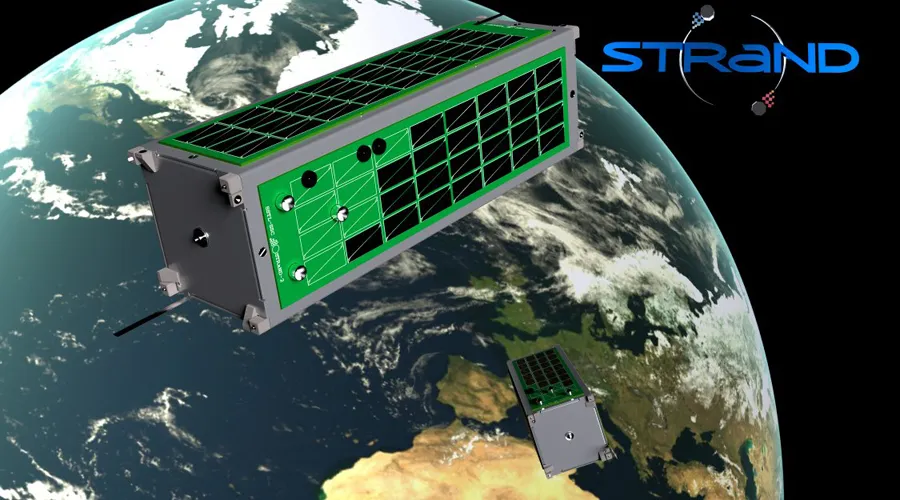
The same technology that detects your dorky "Dance Central 2" moves on your Xbox may soon help small satellites coordinate docking in space. A company is building 12-inch (30 centimeters) satellites that use Microsoft's Kinect sensors to scan the area around them, calculate what's happening in three dimensions and dock to one another. On Earth, in people's living rooms, the Kinect system detects the movements of people standing in front of it for body-controlled video games.
The company, Surrey Satellite Technology in the U.K., hopes that in the future, their small satellites could stack together to build larger pieces of equipment and spacecraft. "It may seem far-fetched, but our low-cost nanosatellites could dock to build large and sophisticated modular structures such as space telescopes," Chris Bridges, a spacecraft engineer at the University of Surrey who is leading the project, said in a statement. The modular scheme would allow researchers to switch out components and update equipment in orbit, Bridges said. Modular satellites could also snap onto other craft to give them extra power, propulsion or computing ability.
The small satellites would act "like space building blocks," said Shaun Kenyon, a Surrey Satellite Technology engineer and another project lead.
No other small, low-cost missions have been equipped to dock while in orbit, according to Surrey Satellite Technology.
Researchers plan to launch a linked pair of their new satellites, called STRaND-2, short for Surrey Training, Research and Nanosatellite Demonstrator-2. The twin STRaND-2s will separate after launch. Once in orbit, the satellites will perform system checks, then link again while in orbit. Their Kinect systems will kick in to coordinate docking once they are near each other.
STRaND-1, STRaND-2's predecessor, is a 12-inch (30 centimeters) satellite that Surrey Satellite Technology built to carry a smartphone into space. The phone is loaded with apps that will measure the magnetic field around the phone during orbit and send "postcards from space." STRaND-1 will launch sometime this year, reported Space Exploration Network in London.
This story was provided by InnovationNewsDaily, a sister site to LiveScience. Follow InnovationNewsDaily on Twitter @News_Innovation, or on Facebook.
Get the world’s most fascinating discoveries delivered straight to your inbox.
