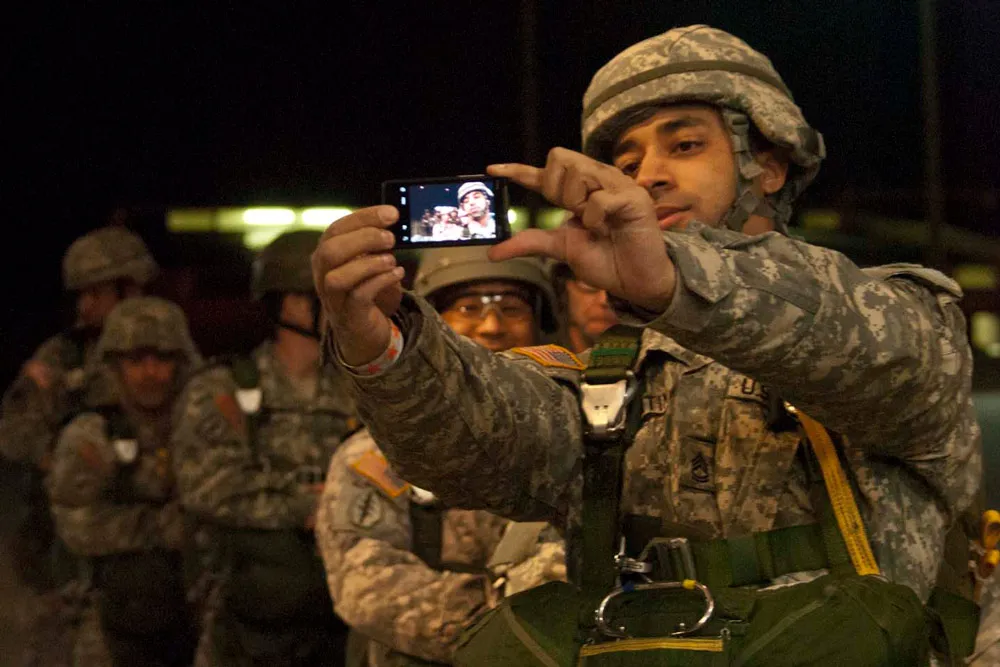
A paratrooper takes a picture with his cell phone before boarding a C-17 to start the airborne operation in which paratroopers donated toys to help children in need during the holiday season.
(Image credit: U.S. Army | Staff Sgt. Sharilyn Wells)
When new U.S. Army attack helicopters landed at an Iraqi base in 2007, soldiers uploaded smartphone photos of the helicopters to the Internet. The soldiers didn’t realize that those pictures contained GPS "geotags," which according to an Army officer allowed insurgents to pinpoint and destroy four Apache helicopters in a mortar attack.
The costly attack highlighted the hazards of social media for the U.S. military — especially when so many applications use the built-in GPS of smartphones to tag the location of users. That's why the Army has made a new effort to warn soldiers about how something as simple as checking into Foursquare can endanger their lives or the lives of their squads.
"Is a badge on Foursquare worth your life?" said Brittany Brown, social media manager at Fort Benning in Georgia.
An Apache AH-64 helicopter conducts a mission in Iraq, April 2007.
(Image credit: U.S. Army)
The act of uploading a smartphone photo to Facebook can broadcast the exact location of Army units, said Steve Warren, deputy G2 for the Maneuver Center of Excellence at Fort Benning. Such dangers make the old World War II propaganda warning of "Loose lips sink ships" seem quaint by comparison.
"Today, in pretty much every single smartphone there is built-in GPS," Warren said. "For every picture you take with that phone, it will automatically embed the latitude and longitude within the photograph."
U.S. military members and their families can avoid such problems by disabling the geotagging feature on their phones and limiting the sharing of social media "check-ins", said Kent Grosshans, an operations security officer for the Maneuver Center of Excellence.
The precautions could also safeguard military families from criminals in the United States while a husband or wife is deployed overseas.
Sign up for the Live Science daily newsletter now
Get the world’s most fascinating discoveries delivered straight to your inbox.
"If your husband's deployed and you go ahead and start posting all these pictures that are geotagged, now not only does an individual know your husband's deployed and he's not at home, but they know where your house is," Grosshans said. "Do you really want everyone to know the exact location of your home or your children's school?"
For the science geek in everyone, Live Science offers a fascinating window into the natural and technological world, delivering comprehensive and compelling news and analysis on everything from dinosaur discoveries, archaeological finds and amazing animals to health, innovation and wearable technology. We aim to empower and inspire our readers with the tools needed to understand the world and appreciate its everyday awe.