













Album: Tools Shed Light on Ancient Temple

Gobekli Tepe Carvings

The reliefs at Gobekli Tepe were carved more than 11,000 years ago on giant limestone blocks. Professor Tristan Carter is seen here beside an image of a creature, possibly a reptile.
Ancient Stone Rings
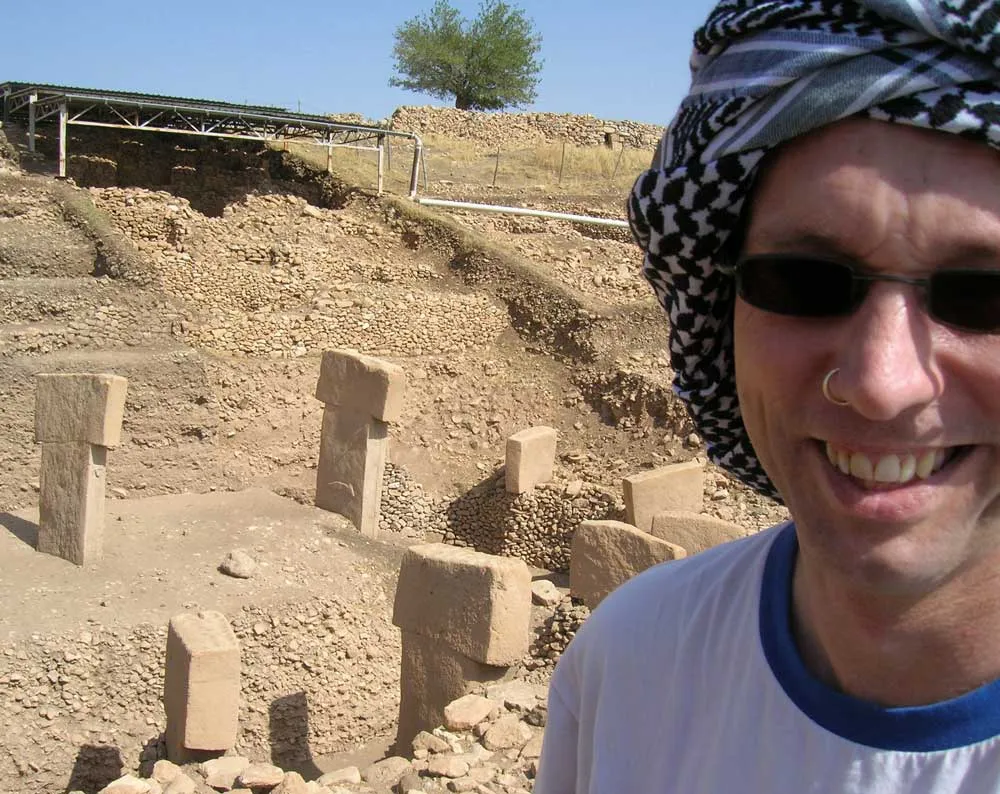
Gobekli Tepe is located in southern Turkey near the modern-day city of Urfa. It contains at least 20 stone rings (circles within a circle) that date back more than 11,000 years. T-shaped limestone blocks line the circles and reliefs are carved on them. Long ago, people would fill in the outer circle with debris before building a new circle within. In this photo Professor Tristan Carter is shown alongside one of the rings.
Obsidian Tests

Obsidian artifacts from Gobekli Tepe are analyzed using Proton Induced X-Ray Emission Spectroscopy (PIXE) at the Louvre museum in Paris. The test helps match up the chemical composition of obsidian with the volcano from which it came.
Mysterious Stone Circles

The stone-circle structures and pillars are shown here at Göbekli Tepe, in southern Turkey.
Lake Van, Turkey

Volcanoes near Lake Van, in eastern Turkey, were identified as a source for some of the Gobekli Tepe obsidian in the new study. It is located about 150 miles (250 km) away.
Central Turkey

Cappadocia, in central Turkey, was identified as a source for some of the obsidian found at Gobekli Tepe. It is located about 300 miles (500 km) away from Gobekli Tepe, about the distance between New York City and Buffalo.
Get the world’s most fascinating discoveries delivered straight to your inbox.

Owen Jarus is a regular contributor to Live Science who writes about archaeology and humans' past. He has also written for The Independent (UK), The Canadian Press (CP) and The Associated Press (AP), among others. Owen has a bachelor of arts degree from the University of Toronto and a journalism degree from Ryerson University.