World's Lightest Solid Takes Inspiration From Eiffel Tower

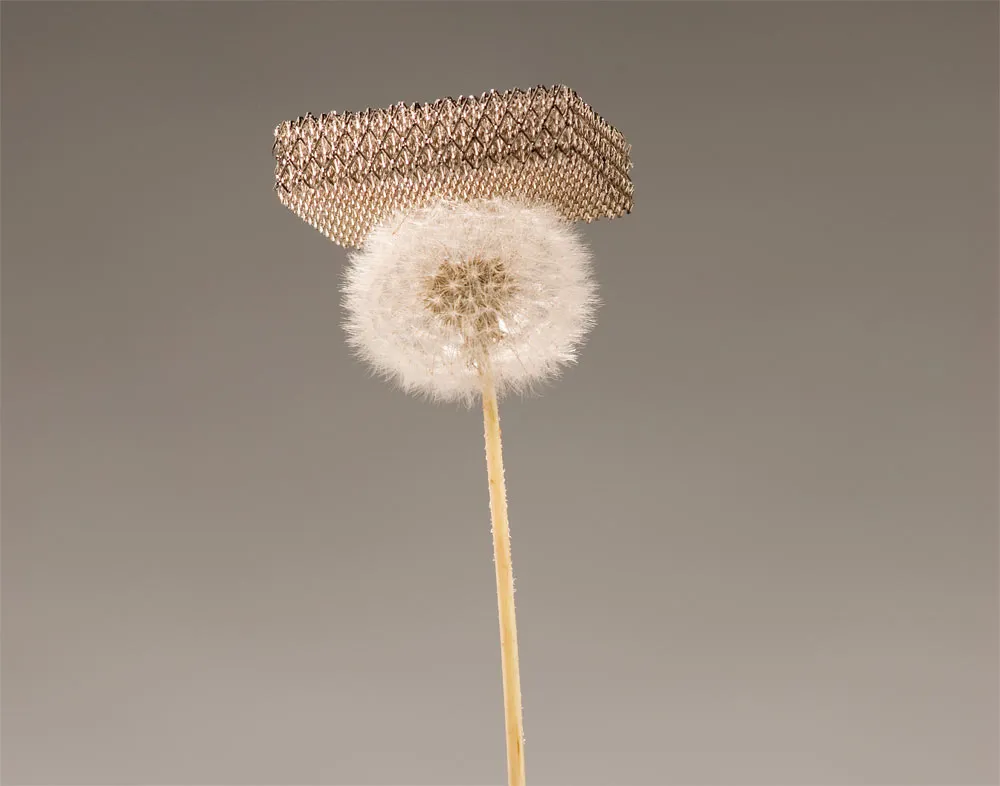
A metallic lattice of hair-thin pipes is now the lightest solid yet created — less dense than air, scientists revealed.
The strategy used to create these intricate structures could lead to revolutionary materials of extraordinary strength and lightness, including ones made of diamond, researchers added.
Ultra-lightweight materials such as foams are widely used in thermal insulation and to dampen sounds, vibrations and shocks. They can also serve as scaffolds for battery electrodes and catalytic systems.
The very lightest substances in the world until now, aerogels, have the ethereal nickname "frozen smoke.” They can reach densities of 1 milligram per cubic centimeter, making them less dense than air at room temperature and sea level.
The problem until now with low-density materials such as aerogels and metallic foams has been their random structures. For instance, aerogels are derived from gels whose liquid components were replaced with gas, leaving behind solid tangles of microscopic-bead necklaces. The chaotic architecture of these substances makes them much weaker than conventional forms of their parent material.
Now scientists have devised ultra-lightweight, low-density metallic lattices with orderly structures. These possess higher levels of stiffness, strength and conductivity of conventional forms of their parent materials, findings detailed in the Nov. 18 issue of the journal Science.
"Our vision is to revolutionize lightweight materials by adopting principles of architecture into their design," researcher Tobias Schaedler, lead scientist at HRL Laboratories in Malibu, Calif., told InnovationNewsDaily.
Get the world’s most fascinating discoveries delivered straight to your inbox.
"If you look at the Eiffel Tower or Golden Gate Bridge, they're incredibly light and strong for their size by virtue of their architecture — the Eiffel Tower is taller and lighter than the pyramids because of its design," Schaedler explained. "We want to achieve the same thing these modern buildings achieve by working on the structures of materials."
The researchers began with a liquid photopolymer — a molecule that changes its properties when exposed to light. They shined patterns of ultraviolet light on this photopolymer, generating a three-dimensional lattice, and coated this structure with a thin film of metal — in this case, nickel-phosphorous alloy.
Next, Schaedler and his colleagues etched away the photopolymer with lye, leaving behind a lattice of hollow nickel-phosphorus struts each 100- to 500-microns wide, or one-to-five times the width of a human hair. The walls of these tubes ranged from 100 to 500 nanometers or billionths of a meter thick, or up to 1,000 times thinner than a human hair.
These lattices are even airier than aerogels, with a density of 0.9 mg per cubic centimeter, "The lattice is 99.99 percent open volume," Schaedler said. "It's about 200 times lighter than Styrofoam."
In experiments, these metal lattices proved very springy, bouncing back to their original shape even after being compressed to less than half their size.
"We're envisioning applications in structural components, such as in aerospace," Schaedler said. "Its energy-absorption capabilities might also make it useful for acoustic-, vibration- and shock-damping. We can control the architecture on the millimeter, micrometer and nanometer scales, to design materials with tailored properties for specific applications, if we want."
The researchers are now experimenting with lattices made of other kinds of materials. "We should be able to make lattices of any thin-film material — for instance, diamond, polymers and ceramics," Schaedler said.
This article was provided by InnovationNewsDaily, a sister site to Live Science.