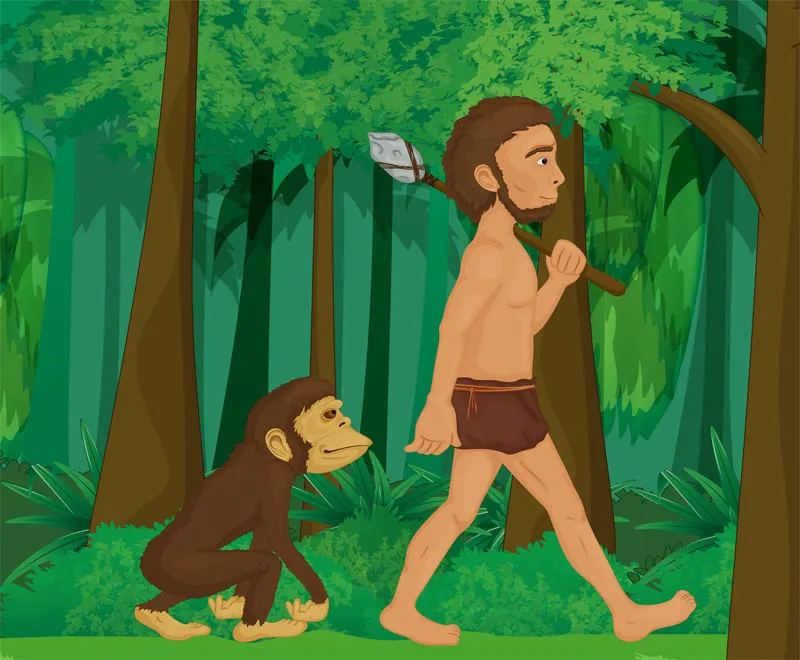
Do our bigger brains drag our bodies down? A theory suggests that because our brains use so much energy, our bodies have to cope by shortening our guts. By studying brain and organ size in humans and 100 other mammals, research suggests that this just wasn't true. Brain size didn't mean that any give mammal had to skimp on other organs.
Half a million years ago, the human brain started expanding. Bigger brains need more energy to keep trucking, but scientists have been stumped as to where we found this extra juice when our metabolic rate, which is how we churn out energy, is on par with our pea-brained cousins.
One recent theory suggests that our brain's need for energy was fed by a smaller gut, since an easier-to-digest diet would free up energy from the gut to build up the brain. New research suggests this might not be the case, that storing energy in our fat deposits is more important.
"Animals with big brains, they had very low adipose [fat] tissue. Animals that had large adipose tissues had smaller brains," study researcher Ana Navarrete, of the University of Zurich, in Switzerland, told LiveScience. "Either you have a much [bigger] brain or a lot of adipose tissue. Usually they are mutually exclusive."
The brain requires about 22 times as much energy to run as the equivalent in muscle tissue. The energy required to run every bodily process comes from the food we eat. Human brains are three times larger than our closest living relative, the chimpanzee, and use up to three times the energy, but the two species have the same metabolic rate.
Ana Navarrete dissected hundreds of mammal carcasses to measure organ masses.
(Image credit: Ana Navarrete, Anthropological Institute and Museum, University of Zurich.)
This extra energy must be coming from somewhere. To figure out where, Navarrete and colleagues analyzed 191 samples from 100 wild and captive mammals. The hope was to pit the so-called expensive-tissue hypothesis (where brain size comes at the expense of gut size) against another idea they had, that fat tissue could be the answer.
They didn't find a correlation between brain size and gut size, but they did find a correlation between brain size and the amount of body fat on an organism. The effect was strongest in wild animals and in females. In addition, the correlation also doesn't hold well for her primate sample (23 of the 100 species analyzed), possibly because these were all captive samples that are more likely to be overweight or underweight than their wild counterparts.
Sign up for the Live Science daily newsletter now
Get the world’s most fascinating discoveries delivered straight to your inbox.
Fatty fund
- Mammal species show positive correlations between organ masses, even after controlling for differences in lean body mass. Only fat stores are smaller, if the brain is relatively large.
(Image credit: Ana Navarrete, Anthropological Institute and Museum, University of Zurich.)
These fat deposits would slow down an animal while it is moving, especially climbing, flying or running to escape predators, but the fat advantage might be an extra source of energy. This suggests, Navarrete said, that survival depends on two strategies: Either you store lots of fat for when times get tough, or you have a big brain to think your way out of sticky situations.
But humans have big brains and abundant fat deposits, meaning when times get tough we can rely on both to survive. There must be something else going on, Navarrete said, suggesting our efficient locomotion may play a role.
Though she didn't analyze a human sample, Navarrete believes that we break the trend because we have a very different style of locomotion than other animals. Walking on two legs is much less energetically demanding than shuffling around the trees on all fours, like our chimpanzee cousins. Because it isn't as costly for us to have extra fat stores, we are able to both store energy and use our brainpower to make the best of scarce resources, she said.
The lack of a human sample concerns other scientists not involved in the study, who said Navarrete's interpretation may be a stretch. "Their results indicate that among primates, fat-mass is not sacrificed in relation to increased brain size," Jack Baker, a researcher from the University of New Mexico who wasn't involved in the study, told LiveScience in an email. "The 'relevance' of the paper is all cast around the relationship of these results to the expensive-tissue hypothesis — which is about human origins specifically."
Even so, "Navarrete and her colleagues have put together an unprecedented data set, which is a significant improvement on what was available almost 20 years ago when Wheeler and I published the original Expensive Tissue Hypothesis [ETH]," Leslie Aiello, a researcher from the Wenner-Gren Foundation in New York who wasn't involved in the study, told LiveScience in an email.
The data set adds more data to the brain-evolution puzzle, but also more questions and complications, suggesting there is not a single answer, and could include a combination of reduced gut size, a higher proportion of body fat, our mode of locomotion and other factors, according to Aiello.
The study was published today (Nov. 9) in the journal Nature.
You can follow LiveScience staff writer Jennifer Welsh on Twitter @microbelover. Follow LiveScience for the latest in science news and discoveries on Twitter @livescience and on Facebook.
Jennifer Welsh is a Connecticut-based science writer and editor and a regular contributor to Live Science. She also has several years of bench work in cancer research and anti-viral drug discovery under her belt. She has previously written for Science News, VerywellHealth, The Scientist, Discover Magazine, WIRED Science, and Business Insider.