













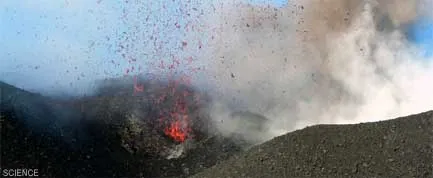
Like rising bubbles in champagne, gases from Earth’s interior can ascend to the surface and cause magma to explode in dangerous splatters.
A new study, detailed in the July 13 issue of the journal Science, shows that these volcanic “gas slugs” originate from deeper inside the planet than previously thought.
The work, by Mike Burton and colleagues at the National Institute of Geophysics and Volcanology in Italy, could help scientists understand why some volcanoes erupt more violently than others.
Like overflowing chili
While the classic image of a volcanic eruption is that of explosive flares that shoot columns of lava and ash into the air, volcanoes are also capable of much milder outbursts.
Called “Strombolian” activity—after the Stromboli volcano in Italy where it has been best studied—these small volcanic blasts consist of relatively viscous lava sputtering from the throat of volcanoes, like over-cooked chili on a stove.
Strombolian eruptions are driven by pockets of water vapor and other gases ascending rapidly through lava tubes inside the Earth. The elongated bubbles, or “slugs,” can measure several tens of meters long and are formed by several smaller bubbles coalescing together as they climb toward the planet’s surface. At Stromboli, the slugs rise at a speed of about 6 feet (2 meters) per second.
Get the world’s most fascinating discoveries delivered straight to your inbox.
(“Slugs” is a scientific term used to describe a bubble with a length at least twice as long as the diameter of the tube through which it travels. It does not refer to slimy gastropods in this context.)
Previous studies based on seismic data have suggested the slugs originate from a depth of at least 820 feet (250 meters), and possibly as much as half a mile (900 meters) beneath a volcano’s summit crater.
Underground plumbing
In the new study, Burton and his team measured changes in the composition of gas escaping from Stromboli during both quiet and active periods. They measured the gas from a safe distance using a beam of infrared light that can detect chemicals in the air. The chemical composition of the gases can be used to gauge the pressure at which they formed, and thus the depth at which the slugs originated.
The team’s findings suggest the gas slugs formed as deep as 1.7 miles (2,700 meters) below the surface.
Steve Lane, a volcanologist at Lancaster University in the United Kingdom, who was not involved in the study, said the new findings are “very important” and will help scientists understand how the structure of Stromboli’s hidden plumbing system changes with depth, as well as how fluid flows within the conduits.
“These changes are often precursors of change in eruption style and provide a powerful forecasting tool,” Lane told LiveScience.
- Super Volcano Will Challenge Civilization, Geologists Warn
- Natural Disasters: Top 10 U.S. Threats
- IMAGE GALLERY: Wild Volcanoes