













Fluctuating Climate May Impede Fleeing Animals

Climate change is expected to send many species on one-way migrations in search of new homes as their old ranges become inhospitable. Whether or not they can survive this century depends a great deal on what happens along the route, a new study has shown.
Scientists looked at 15 species of amphibians in the western United States, which they estimated travel about 15 miles (24 kilometers) per decade, following suitable habitat.
Using computer modeling, they found that the fickle nature of climate change, which can cause fluctuations in local conditions rather than steady change, could interfere.
None of the 15 species of frogs, salamanders and toads is currently endangered. However, when the year 2100 arrived under the simulation, eight species would be extinct or, at best, endangered. However, the outcome for the individual species wasn't the point of the study, according to Dov Sax, one of the researchers and an ecologist at Brown University. [Album: Bizarre Frogs, Lizards and Salamanders]

"Our paper is not trying to make predictions about the fate of individual species," Sax said, explaining that it was intended to examine how species' ranges shift in response to climate change.
"The dynamics we are examining are likely to lead many species to become endangered, even species that aren't currently of conservation concern," he said.
The researchers picked amphibians, because they have an average ability to pick up and leave when things get bad, falling somewhere between migrating birds' ability to fly between continents and plants, which can only hope their seeds wind up in a better place. In addition, there is substantial data available on where these species live and what conditions they can tolerate.
Get the world’s most fascinating discoveries delivered straight to your inbox.
The researchers combined the amphibian data with projections from climate models using two emissions scenarios, one that projected more conservative increases in greenhouse gases and the other projecting more extreme increases. They looked at how the change would play out along paths the creatures could take — broken down into cells one-eighth of a degree latitude by one-eighth of a degree longitude, or roughly 54 square miles (140 square kilometers) — in decade-long increments from 1991 to 2100. [Earth in the Balance: 7 Crucial Tipping Points]
They found that gaps in the animals' treks to new homes were caused when local climate became too hot, too dry or otherwise inhospitable to a species for too long a period. These gaps formed barriers preventing species from continuing their northward shift.
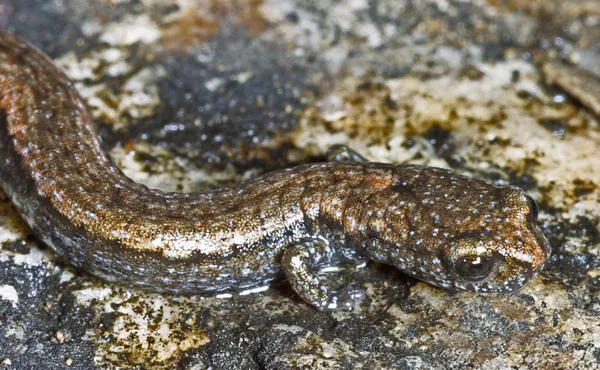
For example, during the latter half of this century, the speckled black salamander could expand from its range in northern California, north into Oregon. However, in the simulation, climate fluctuations rendered areas along that path unsuitable — for example, between 2071 and 2080 — preventing the animal from spreading toward Washington.
For some species, this dynamic could mean losing territory as their current habitat shrinks and they are unable to expand into new areas. This puts them at a greater risk of extinction, according to Sax.
A species' ability to persist outside its optimal habitat can determine whether a climate fluctuation would block its journey. However, persistence is a characteristic that is poorly understood for most species on the planet, Sax said.
The findings mean that simply creating corridors through which species can travel as their habitat changes may not be enough to save them, since fluctuations (rather than physical barriers) can block their paths, according to the researchers. And so in order to preserve wild populations, conservationists may need to relocate populations to new, suitable habitat, which they could not reach on their own, according to Sax.
While conservationists have attempted this practice, called assisted migration, it's controversial, because it calls to mind the damage done by invasive species, which flourish outside their native ranges after humans relocate them.
While the findings focused on the more conservative greenhouse gas-emissions scenario, their analysis showed that the more extreme scenario could result in a larger area of suitable habitat opening up, but that these new areas were often more difficult to reach, according to Regan Early, also a study researcher and a postdoctoral fellow at the Universidade de Évora in Portugal.
Their work appeared online in the journal Ecology Letters on Wednesday (Sept. 28).
You can follow LiveScience writer Wynne Parry on Twitter @Wynne_Parry. Follow LiveScience for the latest in science news and discoveries on Twitter @livescience and on Facebook.
