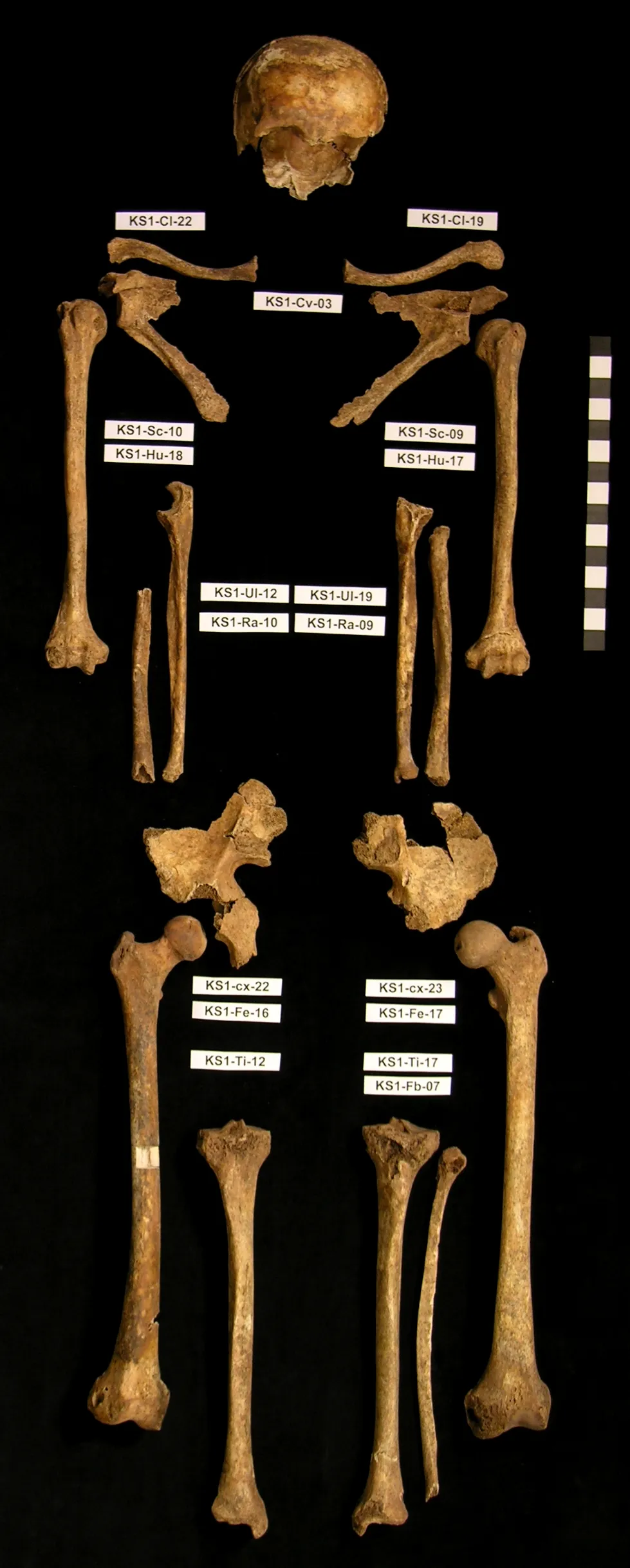
The remains of one man found in a mass grave in Kassel, Germany. Since it wasn't clear which bones belonged to whom, Anna Zipp, of Göttingen University, assembled the bones by individual. The 18 individuals she and colleagues studied were all male, and are believed to have been soldiers in the Napoleonic Wars. A genetic analysis found evidence of the bacterium that causes trench fever in three of the men's remains.
A mass grave, uncovered during construction at a German university, held the remains of about 60 people, with little evidence of their identities and how they ended up there. Now, almost four years after the discovery, a genetic analysis of bones from the site has revealed clues to a possible killer.
The bodies had been uncovered in January 2008 on the grounds of the University of Kassel, and suspicions first turned to the Nazis, who had forced thousands of slave laborers during World War II to work at an area factory producing locomotives and tanks, the Associated Press reported.
Since the discovery, however, analyses of the bones suggest an infectious fever, rather than the Nazis, were responsible for the deaths, and that the bodies belonged to soldiers who fought long before World War II.
The Nazi connection seemed to make sense at first, as in the final days of the war, the Nazi SS shot and buried victims in other parts of Kassel, though there were no reports of mass murders on that site, the AP quoted city archivist Frank-Roland Klaube as saying in 2008. [8 Grisly Archaeological Discoveries]
The bodies themselves did not carry some of the ordinary clues used to identify remains; no rings, watches, coins, uniforms and other similarly revealing items.
Later — much to the city's relief — the investigation pointed to a much older identity for the bodies, according to Philipp von Grumbkow, a doctoral student at Göttingen University who headed up the project to analyze the bones for signs of infectious bacteria.
Sign up for the Live Science daily newsletter now
Get the world’s most fascinating discoveries delivered straight to your inbox.
A carbon-14 analysis — which relies on the decay of a radioactive form of carbon to date organic artifacts — put the bones at roughly 200 years old. A military hospital had been located nearby during the 19th century, prompting investigators to believe that the bones belonged to soldiers from the Napoleonic Wars, which ended in 1815. In addition, the bodies appeared to be male, most of them between ages 16 and 30, according to von Grumbkow.
Another individual pieced together from the jumbled remains of about 18 men, who were among those buried in mass grave in Kassel, Germany.
(Image credit: Anna Zipp)
Tiny killers
Historical records indicated soldiers fleeing the Battle of Leipzig, where a coalition of forces defeated Napoleon Bonaparte, carried a typhoid fever epidemic to all of the towns they encountered in the winter of 1813-14. However, it's not clear specifically what happened in Kassel — then part of Napoleon's empire — because the city's archive burned to the ground during World War II, according to von Grumbkow.
Historically, "typhoid fever" actually encompassed a number of bacterial infections that produced a high fever and red spots on the skin.
Recently, with access to the bones of about 18 men, von Grumbkow and his colleagues set out to check them for the presence of four different bacteria known to produce similar infections.
These included the microbes known to be responsible for typhoid fever, a life-threatening disease caused by food- or water-borne bacteria, as well as the similar but less common paratyphoid fever. They also tested for the pathogen responsible for epidemic typhus, spread by body lice and also potentially fatal if untreated by antibiotics. The final suspect was a bacterium known to cause trench fever, an infection first identified among troops in World War I. It is also spread by body lice. [7 Devastating Infectious Diseases]
The researchers examined the bones, which von Grumbkow said were in a state of "chaos," and organized them by individual as best they could. To make sure they didn't double-sample any one individual, they took bits of bone from only the right thigh or upper arm bones.
To identify any bacteria present in the samples, von Grumbkow and colleagues looked for five specific sequences of DNA, the genetic code found in all life. Each of four of the sequences was specific to a species of suspect bacteria, and the fifth sequence acted as a control to ensure that their analysis was working correctly.
Of the 18 samples, they found three contained DNA from Bartonella quintana, the pathogen responsible for trench fever.
Decades after being identified among German and Allied troops in the First World War, trench fever, which causes attacks of fever along with headache, shin pain and dizziness, is now re-emerging among the homeless populations in cities in the U.S. and Europe. While disabling, trench fever has not been blamed for any deaths in modern times.
But such an infection might have been different for these men, according to von Grumbkow.
These men, most likely soldiers in Napoleon's army, may have traveled through half of Europe and back again, fighting many battles. They were likely under extreme physical stress; they had poor hygiene, which welcomed lice; and they were contending with the cold of winter and a scarcity of food.
"Under such conditions B. quintana could easily spread and the slightest fever could kill," von Grumbkow wrote in an email to LiveScience.
Because bacterial DNA is present in the samples only in small amounts compared to human DNA, it's likely other people were infected as well. And it is also possible that something else killed the men, von Grumbkow said.
The researchers are seeking funding to continue looking for other pathogens.
The research appears in the September issue of the American Journal of Physical Anthropology.
You can follow LiveSciencesenior writer Wynne Parry on Twitter @Wynne_Parry. Follow LiveScience for the latest in science news and discoveries on Twitter @livescience and on Facebook.
Wynne was a reporter at The Stamford Advocate. She has interned at Discover magazine and has freelanced for The New York Times and Scientific American's web site. She has a masters in journalism from Columbia University and a bachelor's degree in biology from the University of Utah.