Researchers have constructed an invisibility cloak capable of hiding a tiny object by altering the behavior of the light that hits it. This is the first invisibility cloak made out of sophisticated, artificial materials called metamaterials that work for the full spectrum of light visible to the human eye.
The cloak the researchers constructed and tested could disguise a miniscule object, 0.000024 inches wide by 0.000012 inches high (6 microns high by 300 nanometers wide) — roughly the size of a red blood cell or 100 times thinner than a human hair, according to study researcher Majid Gharghi, a postdoctoral fellow at the University of California, Berkeley.
Until now, metamaterial cloaks such as this one have only hidden objects from limited parts of the electromagnetic spectrum, outside the range of what we can see or for only part of the visible range. And another type of device, made of calcite crystal prisms, has been used to hide things in white, or full-spectrum, light, but only if wavelengths of that light are traveling at a particular angle, or are properly polarized.
Latest Videos From
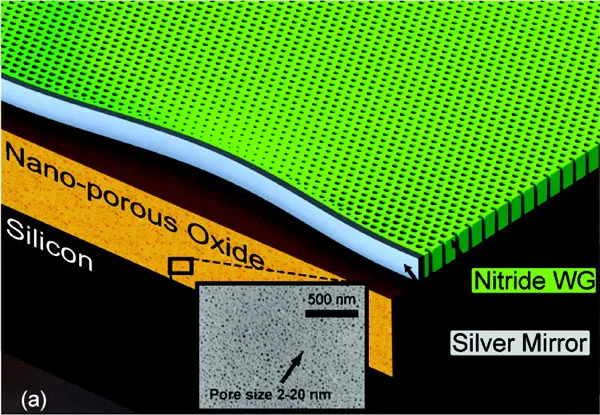
The cloak, which works for the full spectrum of visible light traveling at any angle, is made out of silicon nitride layered on top of silicon oxide with minute pores. The silicon nitride is etched with a special pattern of holes. Because of their carefully calculated size, these holes can alter the speed at which light travels through the layer that contains them. This allows the engineers to manipulate our ability to see things.
"What you see is actually not just the light; what you are seeing is how the light is interacting with its environment," said Chris Gladden, a graduate student in Xiang Zhang's group at UC Berkeley, where the work was done.
The pattern of microscopic holes essentially reconstructs the reflected light as if the light never hit the object in the first place, fooling the eye into missing the object.
In theory, at least, this approach could be used to cloak much larger objects.
"The problem becomes actually making a cloak that big. The cloak Majid and I created consists of about 7,000 holes," Gladden said.
It takes about a week to construct a microscopic cloak like this. While the cloak could be scaled up, eventually the time required would make the project impossible, they said. However, some techniques being developed might reduce that time.
Another logistical issue: The cloak must be much larger than the object it covers. Nevertheless, this cloak is a step forward in invisibility technology.
The research appears in the journal Nano Letters.
You can follow LiveScience writer Wynne Parry on Twitter @Wynne_Parry.

 Live Science Plus