













Ancient City Mysteriously Survived Mideast Civilization Collapse

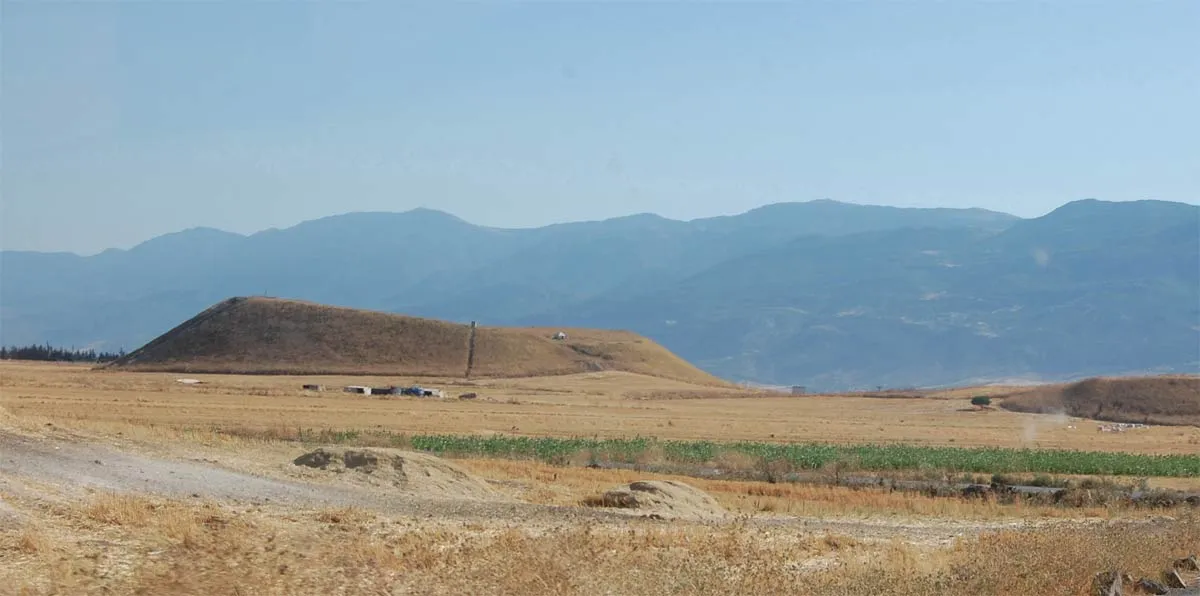
As ancient civilizations across the Middle East collapsed, possibly in response to a global drought about 4,200 years ago, archaeologists have discovered that one settlement in Syria not only survived, but expanded.
Their next question is — why did Tell Qarqur, a site in northwest Syria, grow at a time when cities across the Middle East were being abandoned?
"There was widespread abandonment of many of the largest archaeological sites and ancient cities in the region and also large numbers of smaller sites," said Jesse Casana, a professor of anthropology at the University of Arkansas. "At Tell Qarqur and probably at other sites also in the Orontes River Valley, where our site is located, [settlement] continues, and in our case, seems to have probably broadened [during that time]."
Casana and Boston University archaeologist Rudolph Dornemann discovered mud-brick homes beyond the city's fortification walls, suggesting the area was thriving. [See images of the ancient city]
"It seems like there is an intensively occupied core and fortified area, and more dispersed settlement surrounding it," said Casana. One of the team members, Amy Karoll, presented the research at the 76th annual meeting of the Society for American Archaeology in April.
Digging up history
Tell Qarqur was occupied for about 10,000 years, between 8,500 BC and AD 1350 While excavations have taken place off and on for nearly three decades now, only a small portion of the city has been excavated so far. The long history of the site makes digging down to the 4,200-year-old remains difficult. To compensate, the team has used Ground Penetrating Radar to help map structures beneath the surface.
Get the world’s most fascinating discoveries delivered straight to your inbox.
One of the most interesting excavated finds is a small temple or shrine made out of stone that also dates back 4,200 years. "It's a small stone building with a whole series of plastered basins inside the building that were used probably in some kind of libation ritual," said Casana.
The team also found large standing stones, bones from baby sheep, cult stands used for incense and decorative figurines, some of which are now on display in a local museum.
Global climate change
Environmental data gathered from numerous sources, including ocean sediment cores and plant remains, suggests that there was a climate event that rocked the Middle East and much of the planet 4,200 years ago. [10 Surprising Results of Climate Change]
"At 4,200 years ago, there was an abrupt climate change, and abrupt drying, and abrupt deflection of the Mediterranean westerly winds that transport humid air into the eastern Mediterranean region," Harvey Weiss of Yale University told LiveScience.
Weiss has been researching the phenomenon, working with other scholars to figure out how broad an event this was and what its effects were.
"That deflection of those winds reduced the annual precipitation across western Asia for about 300 years," he said, with rainfall being reduced somewhere between 30 and 50 percent. This meant that cities in the Middle East that depended on rain-fed crops had a difficult time surviving.
The intense drought extended nearly globally, Weiss noted.
Along with the Mesopotamian and eastern Mediterranean societies that met their demise, Old Kingdom Egypt, a civilization that built the Great Pyramids, collapsed. "A different weather system reduced the flow of the Nile River at the same period so the Nile was affected," Weiss said.
Casana cautioned that not all scholars are convinced that climate change was the main cause for the collapse of cities in the Middle East.
"It's a pretty thorny question," Casana said.
Some researchers "simply don't like the sort of one-to-one causal story that that kind of narrative tells, in which the rain stopped falling and everybody died," he said, adding that the way people were farming and using the land may also have played an important role.
Another factor is the shaky political stability that large states sometimes endure. "There are other scholars who simply think that the decline of these civilizations, at that time, is kind of part and parcel of the story of civilization itself," Casana said.
Why did Tell Qarqur survive?
The question now is why Tell Qarqur is different. Why did the site survive and expand while so many others collapsed? Casana said that until more excavation is done, the jury will still be out as to why.
Weiss believes that the Orontes River, on which the city is located, is the key to answering this question. He pointed out that other archaeological sites on the river, including Qatna and Nasriyah, also appear to have prospered during this time of collapse.
"The Orontes River is fed by a huge underground chamber of water, which is called a Karst," Weiss said. "That huge underground source of water continued to flow and to feed the Orontes River during this period when rainfall was diminished."
There are other questions. Before the collapse hit, Tell Qarqur was within the sphere of influence of a powerful kingdom known as Ebla. That kingdom was destroyed sometime prior to 4,200 years ago. This likely changed the way the city was governed and managed, something that future excavations may reveal.
"What happens to the political realities of the community at Qarqur I don't know," said Casana. "I'm sure there must have been some change."
Weiss said that the discovery of cities that grew during climate collapse offers a new frontier for archaeologists and scientists to investigate.
"I think that the early bronze four [the scientific name for this period of collapse] culture of the Orontes is only just now emerging for our attention and that it's going to provide an extremely interesting example of cultural growth in unique environments during this period," he said.
Follow LiveScience for the latest in science news and discoveries on Twitter @livescience and on Facebook.

Owen Jarus is a regular contributor to Live Science who writes about archaeology and humans' past. He has also written for The Independent (UK), The Canadian Press (CP) and The Associated Press (AP), among others. Owen has a bachelor of arts degree from the University of Toronto and a journalism degree from Ryerson University.