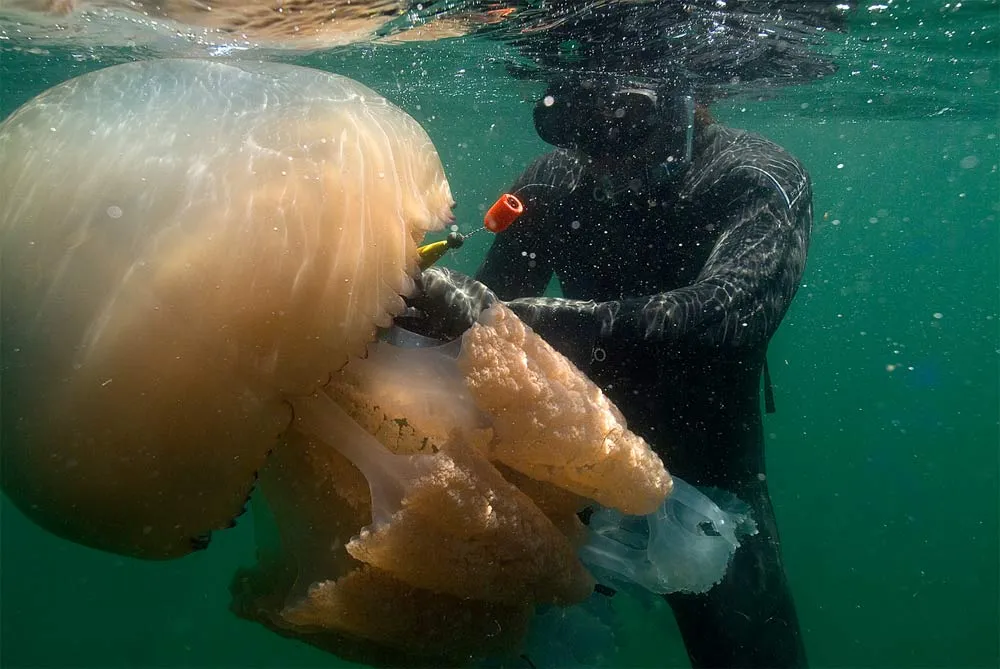
Jellyfish actively swim high and low to catch food, rather than drift passively, according to a study of large barrel jellyfish off the Welsh coast. This behavior may explain some of gelatinous blobs' success.
"It is just another feature of jellyfish that is going to help them outcompete fish and take over from fish in disturbed ecosystems," said lead researcher Graeme Hays, a professor at Swansea University in Wales.
Since jellyfish and young fish both eat plankton (tiny floating plants and animals), jellyfish can quickly gain an advantage when some other disruption — such as overfishing, or a low-oxygen environment created by nutrient pollution — hurts fish populations.
In fact, in recent years, reports of swarms of jellyfish have suggested human-caused changes to ocean environments may be just what these creatures need to thrive.
Barrel jellyfish can weigh up to 44 pounds (20 kilograms) and reach 3.3 feet (1 meter) in diameter.
Hays and colleagues attached tags with time and depth-recording devices to barrel jellyfish — creatures that can weigh up to 44 pounds (20 kilograms) and reach 3.3 feet (1 meter) in diameter. Of the 327 days' worth of data collected from 25 jellyfish, they found that each of the jellies traveled an average vertical distance of 2,031 feet (619 meters) per day.
"The surprising thing is the extent of vertical movement that was taking place in relatively shallow water, only about 33 feet (10 meters) deep," Hays said.
It's quite unlikely the jellies were ascending and descending to evade predators, given the scarcity of their predators — turtles — and the slow speed at which the jellies were pulsing their bells to move, according to Hays. [Album: Amazing Photos of Jellyfish]
Sign up for the Live Science daily newsletter now
Get the world’s most fascinating discoveries delivered straight to your inbox.
When looking at the mathematical properties of the jellies' movements, the researchers found they resembled what is called a Lévy flight, a pattern of movements documented for a variety of predators, including sharks and tuna, as they search for sparsely distributed prey. This is the first evidence of this movement pattern among jellyfish.
Other species of jellyfish are quite likely to behave as the barrel jellyfish does. The barrel jellyfish, or Rhizostoma octopus, belongs to a large family with many closely related species that are big and built to swim strongly, according to Hayes.
The study, published in the journal Proceedings of the Royal Society B, is part of EcoJel, a European Union-funded project examining the impacts of jellyfish.
You can follow LiveSciencesenior writer Wynne Parry on Twitter @Wynne_Parry. Follow LiveScience for the latest in science news and discoveries on Twitter @livescience and on Facebook.
Wynne was a reporter at The Stamford Advocate. She has interned at Discover magazine and has freelanced for The New York Times and Scientific American's web site. She has a masters in journalism from Columbia University and a bachelor's degree in biology from the University of Utah.